|

|
MrBaggins
|
|
Including debt growth.
|
|
| |
|
|
|
The Templar
|
 |
People's Republic of the East Village
Oct 2001
time: 00:34
|
|
quote:
Originally posted by Ned
Templar, the question is not whether the government will be better off, but whether the entire country, which is 70% private sector, would be better off. |
Is that the entire country in the aggregate? Or is that everybody better off? Because if venture capitalists are better off while normal people are stuck paying the tax bill, then that's just redistribution of wealth - from rich to poor.
Nor will that money necessarily "trickle down" - the venture capitalists could spend and invest outside of the US. In that case, the rich get richer, everyone else foots the interest payments, while the monetary gains get spent in a way that does not benefit Americans - i.e. the people who are paying the tax bill on the interest. This is what happened during the '80s and the Reagan "revolution".
I am familiar with your arguments. But history suggests that a bigger pie is not desirable from the average person's point of view if their share is ever shrinking. Suppose the gains by going into debt are not equally distributed, which follows the historical patern (80s and 90s). Then even if everyone pays equally for the resulting interest in the debt (and this doesn't happen either since capital gains have such a sweetheart tax), the average person pays more in tax without reaping the benefit.
No thanks on the increased debt thing unless the government shifts the tax burden thereby created wholly onto the direct beneficiaries. And why should they complain if they are doing better than breaking even?
Distribution, as always, is the most important question.
|
|
| |
|
|
|
Ned
|
 |
of Aptos, CA
Oct 1999
time: 21:34
|
|
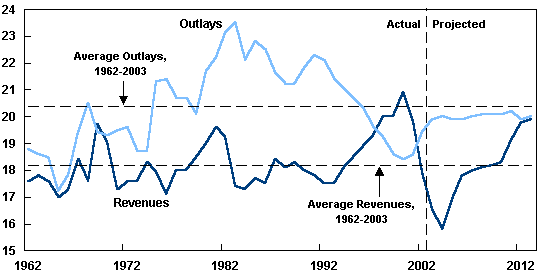
Just so we are on the same page, here are some data from OMB.
code:
2003 2004 2005 2006 2007 2008 2009 2010 2011 2012 2013 2014 2005-2009 2005-
2014
--------------------------------------------------------------------------------
In Billions of Dollars
Total Revenues
code:
 1,782 1,817 2,049 2,256 2,385 2,506 2,644 2,786 3,036 3,272 3,441 3,629 11,840 28,004
Total Outlays
code:
2,158 2,294 2,411 2,525 2,652 2,783 2,912 3,047 3,198 3,296 3,457 3,616 13,282 29,897
Total Deficit (-) or Surplus
code:
 -375 -477 -362 -269 -267 -278 -268 -261 -162 -24 -16 13 -1,443 -1,893
On-Budget
code:
-536 -631 -535 -464 -477 -504 -507 -511 -421 -299 -294 -277 -2,487 -4,288
Off-Budget
code:
161 154 174 195 211 226 239 249 259 275 278 290 1,045 2,395
Debt Held by the Public at the End of the Year
code:
 3,914 4,393 4,771 5,055 5,338 5,630 5,912 6,185 6,356 6,388 6,409 6,399 n.a. n.a.
As a Percentage of GDP
Total Revenues
code:
 16.5 15.8 16.9 17.8 18.0 18.1 18.2 18.3 19.1 19.8 19.9 20.1 17.8 18.7
Total Outlays
code:
 19.9 20.0 19.9 19.9 20.0 20.1 20.1 20.1 20.2 19.9 20.0 20.0 20.0 20.0
Total Deficit (-) or Surplus
code:
 -3.5 -4.2 -3.0 -2.1 -2.0 -2.0 -1.8 -1.7 -1.0 -0.1 -0.1 0.1 -2.2 -1.3
Debt Held by the Public at the End of the Year
code:
 36.1 38.3 39.5 39.9 40.3 40.6 40.7 40.7 40.1 38.6 37.0 35.4 n.a. n.a.
--------------------------------------------------------------------------------
[/code]
http://www.cbo.gov/showdoc.cfm?index=4985&sequence=1
 Attachment: 498501.gif Attachment: 498501.gif
This has been downloaded 59 time(s).
Last edited by Ned on 10-03-2004 at 06:10
|
|
| |
|
|
|
Kidicious
|
 |
Diety of Kidiverse
Mar 2003
time: 21:34
|
|
quote:
Originally posted by el freako
Just to clarify...
That 5% a year growth in GDP is the nominal growth rate (i.e. that before adjusting for inflation) - real growth is more likely to be 3% to 3.5%.
However the fact remains that even if the economy booms like it did in 1996-2000 the deficit will remain large (over 3% of GDP) due to the siginificant structural changes.
If nothing is done, and Bush's tax cuts are made permanent (as seems likely) then the US will face budget deficits of 10% to 15% of GDP 15 to 20 years time.
That would either imply the abolition of a major government spending area (like pensions, or education) or a rise in taxation to the levels currently prevailing in europe. |
You make a giant leap. Anyway let us worry about 15 to 20 years in at least 10 years time. To do otherwise is just not usefull.
edit: If you plan for 15 years your economy will be screwed in 5 years as well as 15 years.
Last edited by Kidicious on 10-03-2004 at 06:50
|
|
| |
All times are GMT. The time now is 05:34.
Apolyton Time is 00:34. |
top of page
|
| archivepost |
|
Forum Rules:
You may not post new threads
You may not post replies
You may not post attachments
You may not edit your posts
|
HTML code is ON
vB code is ON
Smilies are ON
[IMG] code is ON
|
|
|
|
|
|







 10-03-2004 00:57


 .
.


 |
|