|
| |
|

|
The Mad Monk
|
 |
of Ice Cream
Mar 2000
time: 23:19
|
|
FOR GOD'S SAKE, JUST STOP, OKAY? JUST ****ING STOP, IT ISN'T WORTH THIS!
quote:
Man commits suicide at Ground Zero
BY ROCCO PARASCANDOLA, DEBORAH MORRIS AND SEAN GARDINER
Staff Writers
November 6, 2004, 7:11 PM EST
Distraught over the re-election of President George W. Bush, a Georgia man traveled to New York City, went to Ground Zero and killed himself with a shotgun blast, police said yesterday.
The suicide victim, Andrew Veal, 25, was discovered just before 8 a.m. yesterday when a worker for the Millennium Hotel looking at Ground Zero from an upper floor saw a man lying atop the concrete structure through which the 1 and 9 subway lines run.
The worker, thinking the man was sleeping, alerted colleagues and the Port Authority police were notified.
But when they got to Veal's body, they realized he had killed himself with a shot to the head from a .12-gauge shotgun.
No suicide note was found, but according to a Port Authority police source, family members said Veal, a registered Democrat, was despondent over Bush's defeat of Sen. John Kerry. A second source said Veal, who lived in Athens, Ga., and worked for the University of Georgia, was also adamantly opposed to the war in Iraq.
More than three years after the Sept. 11 terror attacks, Ground Zero remains a top tourist attraction, the site rife with symbolism.
Visitors there yesterday reacted in different ways to news of Veal's suicide. Bobbie Jensen, 54, a Republican from Phoenix, said that while she understood how Bush's victory disturbed those who dislike him, Ground Zero is not the place to act on those emotions.
"You can be upset about the war, about Bush, but this is a sacred place," she said. "You got to accept what happened and not kill yourself." But Frank Franca, an East Village artist and registered Democrat, suggested the suicide was symbolic.
"I'm very moved by it," he said. "Obviously, this person was devastated. I can see why he would come here."
Franca's friend, Jeffim Kuznetsov, a 25-year-old student from Russia who lives in Atlanta, said the suicide is evidence of how deeply many Americans were affected by Kerry's defeat.
"It's a national tragedy," he said. "This election is devastating to all who believe in democracy."
Another visitor to Ground Zero, Arushi Raval, 34, a businesswoman who lives in Chelsea, said Veal might have been active in campaigning for Kerry, only to taste defeat.
"Maybe he felt ineffective," she said of the victim. "You feel ineffective if you tried and it all failed.
"I know so many New Yorkers who are depressed over this."
Copyright © 2004, Newsday, Inc.
|
http://www.newsday.com/news/local/n...ynews-headlines
|
|
| |
|
|
|
MosesPresley
|
|
Both of those acts took a lot of guts.
|
|
| |
|
|
|
David Floyd
|
|
The bottom of a large bottle of beer
Jan 1970
time: 05:19
|
|
quote:
If I receive a draft notice in the next four years, I won't have any options left... |
Sure you will. Burn the sonuva*****, like hundreds of thousands of other Americans will be doing.
|
|
| |
|
| |
|
|
|
The Mad Monk
|
|
of Ice Cream
Mar 2000
time: 23:19
|
|
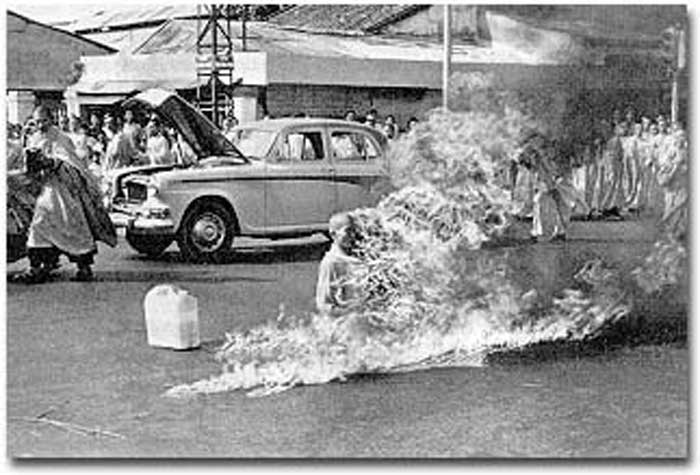
The story behind the immolation picture:
quote:
The Self-Immolation
On June 11, 1963, Thich Quang Duc, a Buddhist monk from the Linh-Mu Pagoda in Hue, Vietnam, burned himself to death at a busy intersection in downtown Saigon, Vietnam.. Eye witness accounts state that Thich Quang Duc and at least two fellow monks arrived at the intersection by car, Thich Quang Duc got out of the car, assumed the traditional lotus position and the accompanying monks helped him pour gasoline over himself. He ignited the gasoline by lighting a match and burned to death in a matter of minutes. David Halberstam, a reporter for the New York Times covering the war in Vietnam, gave the following account:
I was to see that sight again, but once was enough. Flames were coming from a human being; his body was slowly withering and shriveling up, his head blackening and charring. In the air was the smell of burning human flesh; human beings burn surprisingly quickly. Behind me I could hear the sobbing of the Vietnamese who were now gathering. I was too shocked to cry, too confused to take notes or ask questions, too bewildered to even think…. As he burned he never moved a muscle, never uttered a sound, his outward composure in sharp contrast to the wailing people around him.
Thich Quang Duc had prepared himself for his self-immolation through several weeks of meditation and had explained his motivation in letters to members of his Buddhist community as well as to the government of South Vietnam in the weeks prior to his self-immolation. In these letters he described his desire to bring attention to the repressive policies of the Catholic Diem regime that controlled the South Vietnamese government at the time. Prior to the self-immolation, the South Vietnamese Buddhists had made the following requests to the Diem regime, asking it to:
Lift its ban on flying the traditional Buddhist flag;
Grant Buddhism the same rights as Catholicism;
Stop detaining Buddhists;
Give Buddhist monks and nuns the right to practice and spread their religion; and
Pay fair compensations to the victim’s families and punish those responsible for their deaths.
When these requests were not addressed by the Deim regime, Thich Quang Duc carried out his self-immolation. Following his death, Thich Quang Duc was cremated and legend has it that his heart would not burn. As a result, his heart is considered Holy and is in the custody of the Reserve Bank of Vietnam.
While Thich Quang Duc’s self-immolation has received little attention from religious scholars, it has been interpreted from both a religious and political perspective. From the prevailing point of view he has been "exclusively conceptualized as a transhistorical, purely religious agent, virtually homologous with his specifically religious forebears and ancestors." Therefore, his self-immolation is seen as a "religious suicide" and is religiously justified based on Chinese Buddhist texts written between the fifth and tenth centuries C.E.
On the otherhand it has been pointed out by both Thich Nhat Hnah and Russell McCutcheon that by contextualizing the event in 1963 Vietnam, the self-immolation can be seen as a "political act" aimed at calling attention to the injustices being perpetrated against the South Vietnamese people by a puppet government of Euro-American imperialism. In this context, Thich Nhat Hnah describes the act of self-immolation as follows:
The press spoke then of suicide, but in the essence, it is not. It is not even a protest. What the monks said in the letters they left before burning themselves aimed only at alarming, at moving the hearts of the oppressors, and at calling the attention of the world to the suffering endured then by the Vietnamese. To burn oneself by fire is to prove that what one is saying is of the utmost importance…. The Vietnamese monk, by burning himself, says with all his strength and determination that he can endure the greatest of sufferings to protect his people…. To express will by burning oneself, therefore, is not to commit an act of destruction but to perform an act of construction, that is, to suffer and to die for the sake of one’s people. This is not suicide.
Thich Nhat Hanh goes on to explaing why Thich Quang Duc’s self-immolation was not a suicide, which is contrary to Buddhist teachings:
Suicide is an act of self-destruction, having as causes the following: (1) lack of courage to live and to cope with difficulties; (2) defeat by life and loss of all hope; (3) desire for nonexistence….. The monk who burns himself has lost neither courage nor hope; nor does he desire nonexistence. On the contrary, he is very courageous and hopeful and aspires for something good in the future. He does not think that he is destroying himself; he believes in the good fruition of his act of self-sacrifice for the sake of others…. I believe with all my heart that the monks who burned themselves did not aim at the death of their oppressors but only at a change in their policy. Their enemies are not man. They are intolerance, fanaticism, dictatorship, cupidity, hatred, and discrimination which lie within the heart of man.
TOP
The Impact of the Self-Immolation
This famous picture was on President Kennedy's desk that day. As a result, Thich Quang Duc's self-immolation:
Accelerated the spread of "engaged Buddhism" that had begun in Vietnam in the 1930’s.
Led to the overthrow of the Diem regime in South Vietnam in November of 1963.
Helped change public opinion against the American backed South Vietnamese government and its war against the communist supported Viet Cong.
The social and political impact of Thich Quang Duc’s self-immolation was far reaching. It was reported in the New York Times the next day and a copy of the fach Quang Duc in 1963 has been followed by the self-immolation of several monks and by the continued activism of the "rebellious monks of Hue" against the communist government in Vietnam over the past three decades.
Who Was Thich Quang Duc?
Thich Quang Duc was born in 1897 and was 67 at the time of his self-immolation in 1963. He had lived in a Buddhist monastic community since he was seven years old and was ordained as a full Buddhist monk or Bhikku when he was twenty. Thich Quang Duc practiced an extreme ascetic purification way for several years, became a teacher, and spent many years rebuilding Buddhist temples in Vietnam prior to 1943. At the time of his death, he was a member of the Quan the Am temple and Director of rituals for the United Vietnamese Buddhist Congregation. Thich Quang Duc is considered to be a bodhisattva, "an enlightened being - one on the path to awakening who vows to forego complete enlightenment until he or she helps all other beings attain enlightenment."
|
Again...how does this compare to what happened yesterday?
|
|
| |
|
|
|
David Floyd
|
|
The bottom of a large bottle of beer
Jan 1970
time: 05:19
|
|
quote:
More seriously, I'm a little concerned about my own reaction to being given the "opportunity" to kill for my country. I'm not scared of the draft per se...I'm scared of myself. I'd rather not risk losing my soul. I have a darker side that I've worked very hard to weed out of my psyche, but I have no garuntee that I can keep it completely at bay. And that is what terrifies me. |
*shrug* Like I said, there will be plenty of people burning their draft cards - probably more than during Vietnam. File court challenges, refuse induction, and if enough people do it, they can't put you in prison. I think that enough people will refuse the draft to make enforcement of any draft possible - not that I think a draft is likely, though.
|
|
| |
All times are GMT. The time now is 05:19.
Apolyton Time is 00:19. |
top of page
|
| archivepost |
|
Forum Rules:
You may not post new threads
You may not post replies
You may not post attachments
You may not edit your posts
|
HTML code is ON
vB code is ON
Smilies are ON
[IMG] code is ON
|
|
|
|
|
|






 07-11-2004 14:15


 Attachment:



 , but in a more somber way.


 |
|