|
| |
|
| |
|

|
tanelorn
|
 |
of the deep blue sea
Jun 2001
time: 07:23
|
|
To Heresson: Wow man, this is just what I was looking for! Wow man, this is just what I was looking for!
To Valuk (?): I tried hard not to comment on that "Turkicized Greeks" thing, but think about it. Cultural exchange between neighbours is not uncommon, imagine what happens when a totally alien culture is imposed by the conquering nation. It has to leave a mark. This however doesn't transform Russian to Mongols, Polish to Russians or Slovenes to Austrians, Hungarians, Italians, Serbs, Croats, Germans or just for the sake of argument Visigoths, Ostrogoths, Lombards, Huns, Avars, Romans, Franks and so on. 
Trying to define ethnicity by selecting a certain isolated time-frame to set as standard for "National purity" is nonsensical. What is a "pure" national culture? Does it exist?
Trying to define/set rigid cultural barriers between nations is like trying to cut soup with a knife.
Why should cultural interaction be treated as a bad thing? Societies and cultures are enriched by a cosmopolitan environment.
The Italians, the Portuguese, the Greeks, the Russians, the Romanians, the French, the Germans, the Spanish and some Swiss (to name just a few) consider themselves to be either descendants or successors to the Romans, each one in its own different way. Mabye they are all right. Or wrong, depending on the way you look at it.
They have all benefited from Greco-Roman and Judaeo-Christian culture that came along with the Roman empire. Should they be called Hellenized, Romanized or Jewish? And why should this be a bad thing?
To sum up, Valuk: Do you consider yourself to be Yugoslavian? You are old enough to have been Yugoslavian for a while, I believe. What makes you a Slovene now? You woke up one day and Valuk the Yugoslavian had ceased to exist?
I know this is hard, even brutal, on my behalf -with the wars in the Balkans and all, but think that since we are in the same bad neighbourhood, you must know touched that very same string.
|
|
| |
|
|
|
Valuk
|
|
Acres Wild
Oct 2002
time: 05:23
|
|
Tanelorn: Yes, I admit to being a barbarian. Why?
1) My ancestors didn't use steel to up until the ninth century, which can't be stated for your forfathers, aye?
2) Ne, jaz se sploh ne priznavam za Slovenca, temveè sem veè Srba/Ukrajinca/èesarkoli, da bi bil èisti Slovenec.
Did you understand what I just said? Thought so 
I didn't mention the Turkisization of the Greek nation was a bad quality.
But come to think of it, it is, considering that the Turkish Ottoman empire slipped into anarchy and consequentially, barbarism soon after their defeat vs. the Austrians and Venetians in 1700.
From the turkish capture of Byzantium to the 18th century, a certain cultural level was maintained in great cities such as Edirne, Istanbul and Saloniki(oops, I did that on purpouse )
But the Turks soon changed their mind.
"Our greatest mistake" wrote a sage in 1699 "was abandoning the true way of the Dervish".
And when lord Byron arrived into Greece, what did the young noble find? A group of ragged turban- wearing peasants with a distinct hatred of the authority, thought they knew nothing else.
And in Macedonia, things were even worse. The oppression of the Pashas is still felt today.
The Greeks were integrated into balcanic culture, thus also embracing nationalism, a sentiment that hadn't been noted before.
And as the Turks oppressed the Armenians the Greeks turned upon the Macedonian Slavs in an ethnocidal mood, which goes on right to this day.
And the Greek Roumali Nationalist' pages flower like never before, each stating that the glory of the queen of cities MUST be renewed.
Ah, a pity.
And no, I was never Yougoslavian, not the least, thought I have a mainly Serb descent .
Yougolavia fell back in 1991, when I was about five years old.
And I do not consider myself Slovene, and am not nationalistic, I just have a taste for history.
|
|
| |
|
|
|
fairline
|
 |
of the wing
Sep 2002
time: 05:23
|
|
quote:
Originally posted by Palaiologos
To correct one of my previous posts:
The "limitanei" were not the remnants of the old legions. The old legions were incorporated into the field armies. |
Did you get my Notitia Dignitatum e-mail, Palailogos? if you did you will see that the the old legions did become the Limitani and Ripenses, at least on the formation of the field armies under Diocletian. The majority of the field army units were the new Palatini, with some of the old legions and auxilia subsequently being taken into the mobile armies either permanently, as Comitatenses, or temporarily as Pseudocomitatenses.
For example, the Dux Raetiae (Duke/commander of part of the fixed forces on the Danube) commanded Legio II Italica as 5 detachments of Limitani, while the Dux Mesopotamiae had Legio I Parthica and II Parthica as his Limitani Legions. It's worth noting that Limitani also included most of the old auxilia also.
IMHO, you should convert the 'old' legions into less able Limitani in the later stages of the empire (new rules file), while allowing the player to build new legio and auxilia Palatini which retain the combat stats of the early empire legions together with increased movement to allow mobile defence. After all, if the existing legions don't become less combat worthy they will present too great a defence against the barbarian hordes (and I don't mean Russians / Yugoslavians  ) )
In an earlier post you stated that the field army system was not successful - on the contrary, the campaigns of Constantine, and later Julian (at least against the Germans if not the Sasssanids) were execptionally successful. What brought down the Western empire was lack of willing manpower, endless power struggles for the throne and the relentless western migration of the barbarians, not the inherrent weakness of the field army system.
BTW, can't wait for this scenario - it's the one I would have attempted if I had the skill or patience to create scenarios 
|
|
| |
|
|
|
Alexandr
|
|
Russia, Moscow
Sep 2002
time: 08:23
|
|
quote:
Originally posted by Palaiologos
This thread is not about your Polish-Russian differences. Poles have a right to hate the Russians for what they have done to their country. We are not discussing the heir of the Roman Empire here. In my opinion there was no true heir of the Empire.
THIS THREAD IS ABOUT THE ROMAN EMPIRE SCENARIO.
|
Well, sorry... the discussion must be finished here (although there is still a lot to say )
We, Russians, also have enough reasons to feel antipathy against Poland (by the way, today is 390 anniversary of the liberation of Moscow from Polish interventionists); but, as victors, we are above any hatred.
About «Roman Empire scenario». Are you going to realize the phoedus system and (later) the theme army? [There is an idea, about recruiting system, which I tryed to realize in my «Justinian» scenario: the military power of Empire based on barbarians, especially in the «early-Byzantine» period. How it works in Civ: special «diplomat» units - may be diplomat or strategos - which hire barbarians to serve in army and to guard the borders. (This can be found in Prokopius’ writings; for example: when Roman forces suffered a defeat in the war against Persians, strategos Belisarius was sent there to support them - not with an army, but with large amount of money to recruit the army)].
|
|
| |
|
|
|
Valuk
|
|
Acres Wild
Oct 2002
time: 05:23
|
|
Actually, the Russians did win. Poland was nearly a Russian colony until 1991! But now it's over, and Russia and Poland don't have any territorial disputes, come to think of it, they don't even border much anymore(except in former Eastern Prussia).
|
|
| |
|
|
|
Palaiologos
|
 |
Constantinople, Queen of Cities
Aug 2002
time: 05:23
|
|
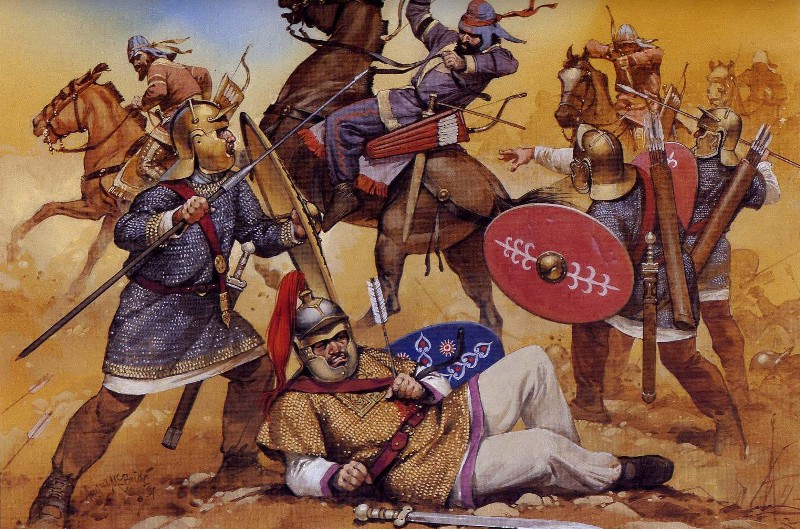
Legionaries of Legio II Parthica repel a Sassanian attack. Messopotamia, 260AD.
 Attachment: messopotamia.jpg Attachment: messopotamia.jpg
This has been downloaded 96 time(s).
Last edited by Palaiologos on 09-11-2002 at 03:37
|
|
| |
|
|
|
Palaiologos
|
|
Constantinople, Queen of Cities
Aug 2002
time: 05:23
|
|
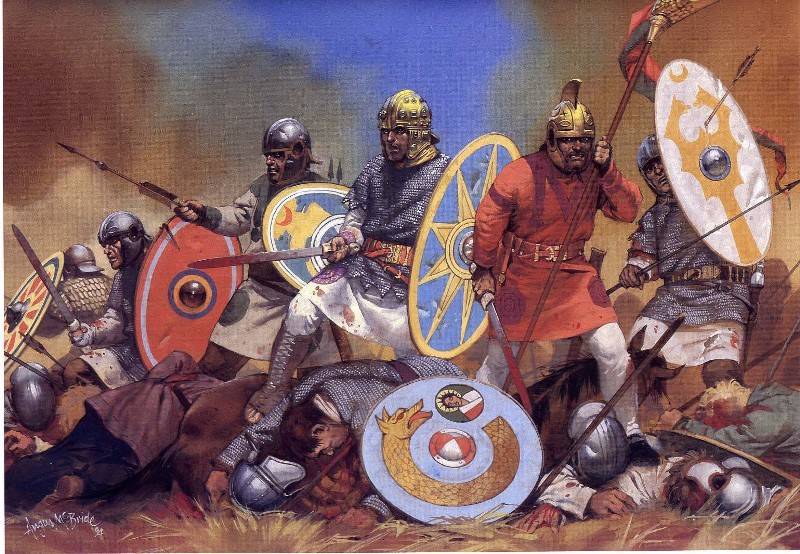
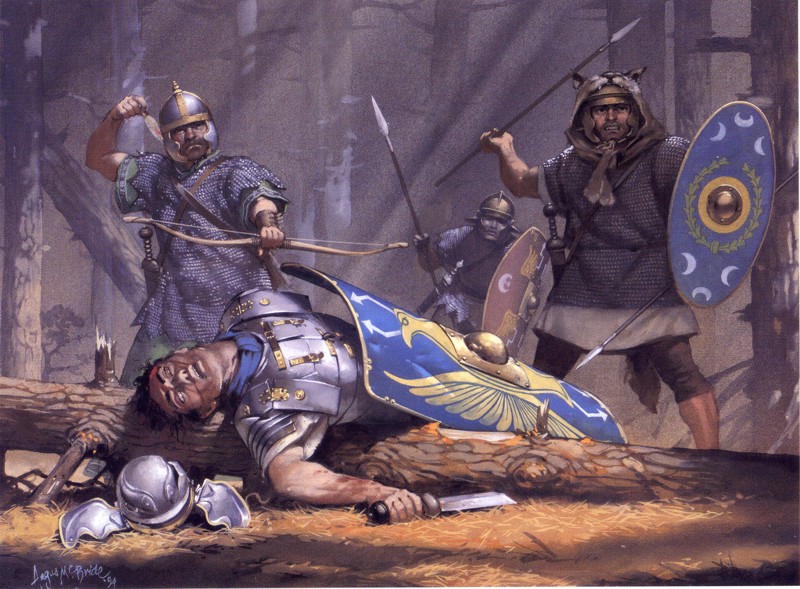
Last stand at Hadrianopolis. The veterans of the scolae prepare to sell their lives dearly. Thrace, Battle of Hadrianopolis, 378AD.
The Draco standard is visible.
Attachment: last stand.jpg
This has been downloaded 91 time(s).
Last edited by Palaiologos on 09-11-2002 at 03:36
|
|
| |
|
|
|
Palaiologos
|
|
Constantinople, Queen of Cities
Aug 2002
time: 05:23
|
|
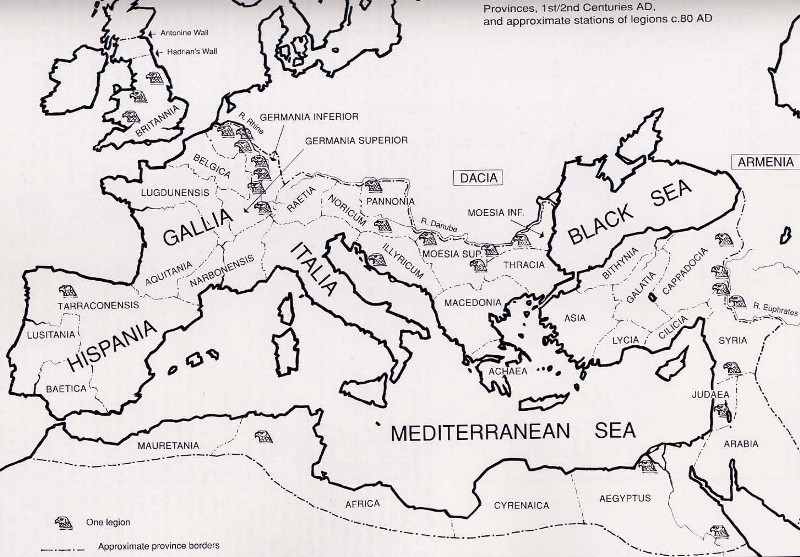
This is ONE of the maps that i was talking about. It shows the aproximate stations of the Legions around 80AD. I have the exact names of the Legions from P.Connoly's "Greece and Rome at War". In the same book there are also the locations of the field armies according to the Notia Dignitatum. However something just doesn't fit. There is a field army in Strassburg, one at Pasau, at Regensburg!!!, at Concordia, at Aquileia!!!, at Rome, Split, Adrianople, Constantinople, Antioch, Cyrene and Dionysias.
Question 1: Why were some field armies positioned so close(the ones at Passau and Regensburg, and the ones at Aquileia and Concordia) ?. Where the Romans campaigning during that time in those areas?
Question 2: Why two field armies in Western Africa? I thought there was only one, cavalry only. The other was located in Tangiers, i think. Can somebody shed some light here?
Attachment: map1.jpg
This has been downloaded 166 time(s).
Last edited by Palaiologos on 09-11-2002 at 14:55
|
|
| |
|
|
|
Valuk
|
|
Acres Wild
Oct 2002
time: 05:23
|
|
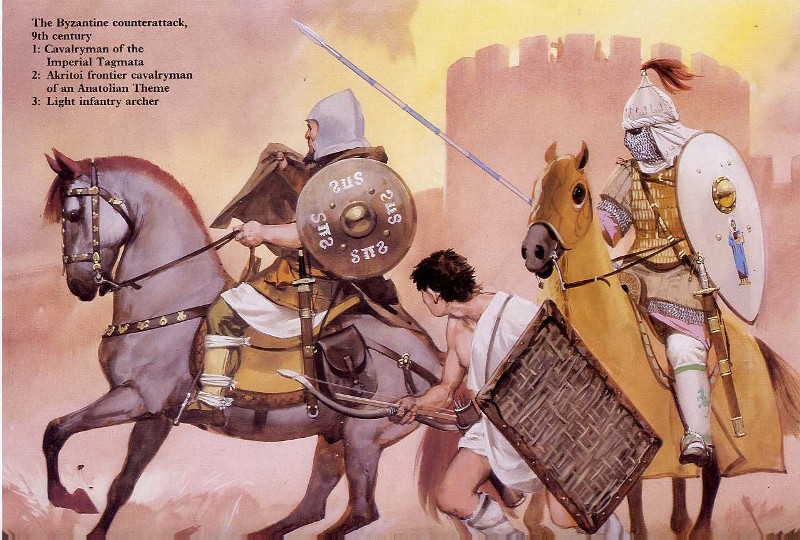
Their cavalry was not as heavily armed as the byzantine kataphraktoi, as there are reports of the 52-year old emperor Heraclius riding down three persian champions in a row at the battle of Nineveh in 627 A.D. and surviving only because of his heavy battle gear.
Try fanaticus.org
Last edited by Valuk on 09-11-2002 at 18:18
|
|
| |
|
|
|
Valuk
|
|
Acres Wild
Oct 2002
time: 05:23
|
|
Ok, got the link right this time.
Last edited by Valuk on 09-11-2002 at 18:21
|
|
| |
|
|
|
Alexandr
|
|
Russia, Moscow
Sep 2002
time: 08:23
|
|
quote:
Originally posted by Palaiologos
What do you know of the Sassanid military?
Did they use War elephants in battle?(i personally doubt it).
My impression is that their army composed of ultra-heavy cavalry(cataphracts) and horse archers. They also used sophisticated siege technics.
What about their infantry? Where they only irregulars and skirmishers or they also fielded heavy infantry?.
|
Yes, they used elephants (may be this type of forces wasn’t very widespread...) In «Epitoma rei militaris» by Flavius Vegetius Renatus (IV - V c. AD) there are some fragments about methods of fighting against Persian elephants. Another example - «History of persian kings» by Tha'alibi: 589 AD, persian battle elephants in the battle against turks (who also had elephants in their army). By the way, in that battle persians used oil-flametrowers («lions») against turkutes’ elephants.
The main force of Persian army - perfect horse archers and heavy-armoured cavalry (which were trained to use bows, too). Persian infantry (irregulars, skirmishers, middle infantry), on the contrary, had very low battle qualities. The siege technics were well developed, of course.
|
|
| |
|
|
|
Civfan
|
|
Toronto, Canada
Sep 1999
time: 05:23
|
|
question 1
around 80 AD the Romans were fighting the hill tribes and the tribes I believe from Dacia. There was a king of the Dacians who if I remember right was causing much trouble to the Romans. It wasn't until Trajan crushed and created serveral provinces out of his kingdom around 105 AD or something like that, and this is when the legions were restationed. I have some books that depict this and theres much information about this I think at the site roman-empire.net.
I'm not 100% right now on this but I believe this is close to an answer that you were looking for. Got to double check on this one!
This is great what your doing. Good luck to you on it.
Civfan..
ps. Actually I found your answer:
http://roman-empire.net/emperors/domitian.html
Last edited by Civfan on 10-11-2002 at 00:14
|
|
| |
|
| |
All times are GMT. The time now is 05:23.
Apolyton Time is 00:23. |
top of page
|
| archivepost |
|
Forum Rules:
You may not post new threads
You may not post replies
You may not post attachments
You may not edit your posts
|
HTML code is ON
vB code is ON
Smilies are ON
[IMG] code is ON
|
|
|
|
|
|






 04-11-2002 04:05





 Attachment:
  |
|