|
| |
|

|
Civfan
|
|
Toronto, Canada
Sep 1999
time: 05:23
|
|
quote:
Originally posted by Palaiologos
When was Venice founded?
I've read that survivors of Attila's sack of Aquilleia founded it, circa 452 AD.
Any idea how to implement this in the scenario?
I can't just create settler units after the fall of Aquileia, since in civ2 cities can't be razed unless size 1.
Plus the player will propably use the settlers to other task, rather than founding a city close to the enemy(Huns). |
Actually you can use the events to remove the city by changing the terrain and then create a unit on another square.
ex.
if city taken
city=Aquileia
defender=Romans
attacker=anybody
then
changeterrain
192,20,192,20,192,20,192,20
end if
its not totally accurate but you should get the picture. Theres a scenario sedpicting the punic wars in which carthage is razed off the map. i think its at csc.
|
|
| |
|
|
|
Civfan
|
|
Toronto, Canada
Sep 1999
time: 05:23
|
|
quote:
Originally posted by Palaiologos
Does anybody have any info on the White Hun invasion of the Persian Empire(454AD)?
And a bit more specialized question: What is known of the infrastructure and road network of the Sassanid Empire? |
Dont know to much about the white huns but the Sassanian king Bahram was able to defeat the White Huns in Persia. Also I'm not sure where the resources are at the moment but if I remember right the White Huns defeated and I think killed a Sassianian king when they entered Persia.
heres a website
http://www.livius.org/sao-sd/sassanids/sassanids.htm
|
|
| |
|
|
|
Civfan
|
|
Toronto, Canada
Sep 1999
time: 05:23
|
|
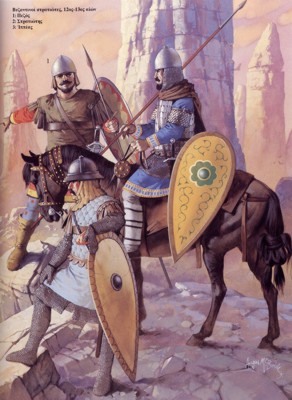
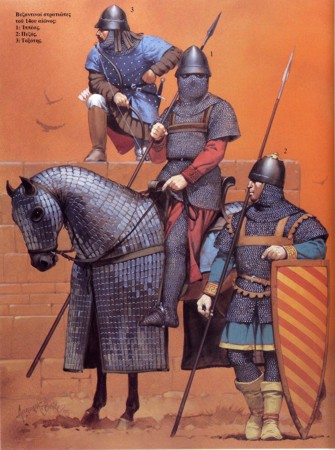
just out of curiousity, what type of military training was there during the byzantine empire. I know it wouldn't be on par with the 1st century romans but any know?
|
|
| |
|
|
|
Palaiologos
|
 |
Constantinople, Queen of Cities
Aug 2002
time: 05:23
|
|
Hmmm.....
Civfan although your question is a bit unclear to me, i will try and answer. I will use the word "Romans" for Imperial armies up to 4th century and "Byzantines" from then on.
The Roman army based its victories on drill and discipline, while the Byzantines on generalship and tactics. To qualify for the officer rank a Byzantine citizen must have been Greek-speaking(not neccesarily of the Greek race) and orthodox in religion.
While the Romans used the same tactic(heavy-infantry block with supporting cavalry on the flanks), the Byzantines used a different tactic against different kind of enemies(from Norman Knights to Persian irregulars and Avars).
During the 9th-10th century the Byzantine Empire fell into a state of anarchy. The Arabs took advantage of this and ravaged Asia minor. The Byzantine warfare then adapted to a form of "Shadowing warfare". Arab bands were carefully followed by a regular army and ambussed while they were full with loot. Effective as this tactic was, it did not prevent collapse of the agricultural economy of Asia Minor. Byzantine counter-raid followed arab raid and the outcome was a destroyed economically zone between the two nations that prevented major military offensives.
Under the reign of the Macedonian dynasty, the Imperial army regained its former glory and vigor and conquered its enemies. However it only slowed the inevitable colapse.
In Leo's "Taktika" the training of the Byz.army is described in full detail. Every footman must learn the use of the bow in addition to that of the spear, and each knight must carry a longbow for mounted use. They must be trained to fight in close as well in open ranks(the infantry). Different enemies require different tactics. The general must not hessitate to lie to his troops about favorable omens in order to motivate them. If facing a superior foe he must camp behind a hill, lest the men understand the odds against them and loose heart. If defeated in battle, the general must not attempt a second "round" while the men have lost confidence in him. It is no dishonour to retreat and reorganize. If leading a large force it is best to invade the enemy's territory as soon as possible, to place the burden of supplying the army on the enemy countryland.
|
|
| |
|
|
|
Stefan Härtel
|
 |
Eddie's best friend
Jul 1999
time: 06:23
|
|
Maybe a little late, but here's what happened with the Hephtalites or White Huns in Persia:
They invaded Persia after AD 400 and became the most important concern of the Persians from that point on. King Peroz was defeated by them twice. In 465, he was defeated on the battlefield and his son was taken hostage; in 484 AD, he was defeated again and this time killed on the battlefield.
What's interesting is that it is quite well-known what happened in this battle; Peroz tried to assault the Huns, but his entire army was trapped in a hidden trench. Nobody survived, and the bodies of the Persians were buried, in Kurgans or Kurgan-like graves (IIRC).
The ultimate effect of this defeat was, that Persia was brought into tributary dependance to the Huns. This again triggered famines and economic troubles in Persia, which peaked in peasant revolts; the most important figure here was Mazdak, whose ideas can nowadays be regarded as communist. Kavad I. at first supported this revolt, but he lost support in the aristocratic circles; he even had to abdicate for a short while before returning to the throne, this time being hostile to the Mazdakites; Kavad and his son, Chosroes I Anoshirvan bloodily crushed the revolts.
Chosroes now introduced some social, economical and military reforms, propably based on some of the Mazdakite ideas; before, however, going to war with the Hephtalites, Chosroes raided Antiochia, thus breaking the "eternal peace" of 532. About 560, the Persians destroyed the Hephtalite/Hun empire with help of the Kok Turks of Central Asia.
As for the Sasanian infrastructure and road networks, it was in typical Persian tradition, thus very good, though not quite as good as the Roman one. All major cities were connected to each other, the road network was most likely based on that of the Achaemenian royal roads.
There was major traffic in the Persian gulf, as all of Arabia from Basra to Oman was under Persian control; ship routes also connected all major cities at the gulf and in the Arabian sea, from Basra to Daibul (near Karachi).
You should also regard the fact that the Persian-Arabian border was heavily fortified since the reign of Shabuhr I.
|
|
| |
|
|
|
Valuk
|
|
Acres Wild
Oct 2002
time: 05:23
|
|
Ok, ok, I'm sorry, I'm just a bit pissed off about the fact that Greece is amongst one of the few countries in Europe who disregards human rights concerning the Aegean Slavic(Macedonian) and Albanian minorities.
But on the other hand, so do the Turks.
|
|
| |
|
|
|
Valuk
|
|
Acres Wild
Oct 2002
time: 05:23
|
|
Yeah, let's.
|
|
| |
All times are GMT. The time now is 05:23.
Apolyton Time is 00:23. |
top of page
|
| archivepost |
|
Forum Rules:
You may not post new threads
You may not post replies
You may not post attachments
You may not edit your posts
|
HTML code is ON
vB code is ON
Smilies are ON
[IMG] code is ON
|
|
|
|
|
|






 01-12-2002 22:13


 Attachment:
 Attachment:
 .
.
 |
|