|
| |
|

|
samson
|
|
This study of hut outcomes was conducted on version 2.4.2, mostly on Deity/raging hordes at various map sizes. It used both reload testing and continous play testing. Both types of tests gave similar statistical results.
The study was done in two parts. The first part was concerned with determining what factors affect the frequency of the five types of outcome: Tribes, Gold, Mercenaries, Scrolls and Barbs. The second part studied the specific results available from each outcome type.
Much of the information reported here is already well known but some conclusions, hopefully, will be new and able to help resolve long standing disputes.
Rules governing the five types of outcomes
There are five possible outcomes from tipping a hut: Tribes (including nomads), Gold, Mercenaries, Scrolls, and Barbarians. The base chance of each of these outcomes is equal (20%), stated as a ratio this is: 1:1:1:1:1. However, certain game circumstances modify this ratio in predictable ways. These can be expressed in six rules.
No Cities Rule
When a hut is tipped by a Civ which has no existing cities and the Turn# is less than 50 (i.e. <1500BC on Diety), then both Tribes and Barbarians are suppressed and their chances are added to Mercenaries. Thus the outcome ratio becomes 0:1:3:1:0 in TGMSB order.
If the Turn# is greater than or equal to 50, then this rule does not apply and the ratio is normal, 1:1:1:1:1. Under these circumstances, it is possible to tip a hut for a Tribes outcome and, on suitable terrain, have it become your capital - complete with a Palace.
Near City Rule
If the distance from a hut to the nearest city is less than 4 (as measured by the rectangle system or the formula for distance given in "Calculating Caravan Delivery Payments") then both Tribes and Barbarians are suppressed and their chances are added to Mercenaries. The outcome ratio becomes 0:1:3:1:0 in TGMSB order.
Nomads Rule
If a Civ has more than one existing nomad (NONE settler) per 8 cities, the nomads-result of the Tribes outcome is suppressed and the chance is added to Scrolls.
With less than 8 cities a single NONE settler suppresses the nomad result. There must be at least 8 cities to support one existing nomad, 16 cities to support two, 24 cities to support three, etc. If not, then Nomads are suppressed and the outcome ratio on nomad-suited terrain becomes: 0:1:1:2:1.
Continent Rule
If a Human Civ tips a hut on a continent on which it has no existing cities (but does have cities elsewhere) and the distance from the hut to the nearest city is greater than 12, then the outcome ratio is: 7:2:2:2:2. In other words, there is a 47% chance of a Tribes outcome under these circumstances.
If the Civ is an AI, then the chance of a Tribes outcome is 100%.
Note, all rules are applied together. For example, under these circumstances if the terrain is nomad-suited and the nomad-result is being suppressed by the Nomads Rule, the Tribes chance is added to Scrolls and the outcome ratio becomes 0:2:2:9:2.
Invention Rule
Once a Civ acquires Invention, the Scrolls outcome is suppressed and its chance is added to Gold. The outcome ratio becomes 1:2:1:0:1 in TGMSB order.
Explosives Rule
After any Civ acquires Explosives, the Nomad result is suppressed and its chance is added to Gold. Thus, on Nomad-suited terrain, the outcome ratio becomes 0:2:1:1:1.
These are, I believe, the only factors affecting the type of outcome from huts. More specifically, the following factors were tested and found to have no statistical effect on hut outcomes:
- The direction of the tile from which the hut was tipped.
- The turn# on which the hut was tipped.
- The type of unit which tipped the hut.
- The terrain of the hut (other than the Tribes/Nomad terrain dependency.)
- The location or continent# of the hut.
Part Two - Results of outcome types
Tribes
The Tribes outcome has two possible results: Advanced Tribes and Nomads. Terrain is the determining factor in which is selected.. Advanced Tribes occur only on Grasslands or Plains. All other terrain types produce nomads. Nomads can also occur on Plains or Grasslands when the surrounding terrain makes the site poorly suited for a city.
The Nomads result is subject to the Nomads Rule and the Explosives Rule (see above).
Before 1000AD, all cities founded from Advanced Tribes have a size of 1. After that date, the size of the city can be 1 to 4. It will always have a Temple. In addition, it has a 50% chance of having a Marketplace, 33% chance of a Granary, and a 25% chance of a Library.
Gold
The Gold outcome has three results: 25 gold, 50 gold, or 100 gold. These occur in a ratio of 4:10:1 on Deity difficulty level. Lower difficulty levels increase the chance of 100 gold and decrease the chance of 25 gold. After the year 1000AD, each of these amounts are doubled.
Mercenaries
There are two result classes of the Mercenary outcome. In general, these can be described as 1-move units and 2-move units. Each of these result classes has an equal chance of appearing from a hut. The specific types of units depend on the discovery of technologies. Once the governing technology has been discovered by any Civ, the unit begins appearing from huts.
Initially, Horsemen and Chariots are available as 2-move units in a ratio of 2:1
Polytheism introduces Elephants. The ratio of Elephant, Horse, and Chariot is 3:2:1.
Chivalry replaces all 2-move units with Knights.
Monotheism replaces all earlier 2-move units with Crusaders.
Leadership replaces earlier 2-move units with Dragoons.
Conscription replaces all 2-move units with Riflemen, a 1-move unit.
Archers are the initial 1-move unit.
Iron Working causes Legions to replace Archers as the 1-move unit.
Gunpowder causes Musketeers to replace Legions as the 1-move unit.
Guerrila Warfare causes Fanatics to replace Musketeers as the 1-move unit.
Mercenary units are supported by the nearest city, unless the nearest city is foreign in which case they are NONE.
Scrolls
The result of a scroll outcome can be any unacquired Civilization Advance for which the Civ has all prerequisites.
The chance of obtaining a specific Advance can be calculated by listing the position numbers of possible advances in an alphabetically-ordered list of all advances (as under @Civilize in Rules.txt). An advance's chance of selection is statistically equal to the distance between its position and the position of the advance above it (wrapping the list from bottom to top).
For example, with no starting techs the list of possible advances and position numbers out of the total of 93 advances would be:
Alphabet 2
Bronze Working 9
Ceremonial Burial 10
Horseback Riding 37
Masonry 48
Pottery 66
Warrior Code 88
And the chances for each advance are:
Alphabet 7/93
Bronze Working 7/93
Ceremonial Burial 1/93
Horseback Riding 27/93
Masonry 11/93
Pottery 18/93
Warrior Code 22/93
Note that Ceremonial Burial, appearing immediately after Bronze Working, has only 1 chance in 93 while Horseback Riding benefits from the long gap between itself and CB.
Barbarians
(incomplete)
General Conclusion.
The assumption of randomness in the determination of hut outcomes appears to be valid. Although sequences of similar outcomes do occur, they are unpredictable and fall within bounds predicted by a random model modified by the rules and conditions described above.
Last edited by samson on 05-12-2002 at 02:24
|
|
| |
|
|
|
Lars-E
|
|
Another classic. Just added it to my "samson's threads". Yes, I searched all threads started by samson and put them in the aforementioned folder. I even think I searched threads where samson posted.
I must be careful with the praise, like the proverb says:
Flattery is nothing less
than setting a trap.
Must soon post an intelligent post in here, only been stupid and ignorant ones for a while. I'm not in it for the count.
|
|
| |
|
| |
|
|
|
Elephant
|
|
Phila PA
Aug 2002
time: 00:24
|
|
Some questions/comments:
quote:
Originally posted by samson
Near City Rule
If the distance from a hut to the nearest city is less than 4 (as measured by the rectangle system or the formula for distance given in "Calculating Caravan Delivery Payments") then both Tribes and Barbarians are suppressed and their chances are added to Mercenaries. The outcome ratio becomes 0:1:3:1:0 in TGMSB order. |
Is this to ANY city, or ONLY your own cities?
quote:
Nomads Rule
If a Civ has more than one existing nomad (NONE settler) per 8 cities, the nomads-result of the Tribes outcome is suppressed and the chance is added to Scrolls.
With less than 8 cities a single NONE settler suppresses the nomad result. There must be at least 8 cities to support one existing nomad, 16 cities to support two, 24 cities to support three, etc. If not, then Nomads are suppressed and the outcome ratio on nomad-suited terrain becomes: 0:1:1:2:1. |
Comment: I think I'd change the wording here from "support" to something like "permit a new nomad".
quote:
Continent Rule
If a Human Civ tips a hut on a continent on which it has no existing cities (but does have cities elsewhere) and the distance from the hut to the nearest city is greater than 12, then the outcome ratio is: 7:2:2:2:2. In other words, there is a 47% chance of a Tribes outcome under these circumstances. |
Again, to ANY nearest city or ONLY to your own nearest city?
quote:
These are, I believe, the only factors affecting the type of outcome from huts. More specifically, the following factors were tested and found to have no statistical effect on hut outcomes:
- The direction of the tile from which the hut was tipped.
- The turn# on which the hut was tipped.
- The type of unit which tipped the hut.
- The terrain of the hut (other than the Tribes/Nomad terrain dependency.)
- The location or continent# of the hut. |
Did you test other difficulty levels, different sizes of maps, or 2.42 vs MGE?
quote:
Nomads can also occur on Plains or Grasslands when the surrounding terrain makes the site poorly suited for a city. |
I was about to respond that I had at least once gotten a nomad on Plains (I think) when I saw your qualifier. Could you comment on what makes the surrounding terrain "poorly suited"?
quote:
In addition, it has a 50% chance of having a Marketplace, 33% chance of a Granary, and a 25% chance of a Library. |
You might want to test to see if having Pyramids suppresses the chance of getting a Granary. In your spare time... Just for the fun of it...
quote:
Polytheism introduces Elephants. The ratio of Elephant, Horse, and Chariot is 3:2:1. |
If Chariots is the "rarer" but more powerful unit, I am suprised that Elephants would be even more likely than Horse to show up once the tech is there. Might make going for PT early a good idea for early conquest games with lots of hut tipping.
quote:
An advance's chance of selection is statistically equal to the distance between its position and the position of the advance above it (wrapping the list from bottom to top). |
I'd love to know how you figured this one out. You are the master!
|
|
| |
|
|
|
samson
|
|
Rah -
The 8 cities/nomad is per Civ. After the discussion of our different experiences with nomads in a recent thread, I figured it might have something to do with style of play. I play mostly OCC or perfectionist style games, whereas MP players are rapid expanders. It was just a matter of adding more and more cities until I started seeing nomads appear when I already had one. Then a little systematic testing to flush out the 8 cities rule.
Lars, Ming - thanks.
Elephant -
Both of the rules that involve the distance to the nearest city mean the distance to ANY city, not just yours.
I did test other difficulty levels. The difficulty level affects the amounts of gold, as I mentioned, and the number of barbarians. Map size appears to have no direct effect on outcomes other than by increasing the number of huts themselves. I confirmed some things on MGE, but original tests were all on 242.
quote:
Could you comment on what makes the surrounding terrain "poorly suited"? |
I haven't been able to quantify it yet, but I believe it has something to do with the food production capacity of the city radius terrain. Perhaps the ability to support a size-N city. Don't know. Might be the same thing that makes the AI decide to found a city on a square or not.
The relationship between the chance of a specific Advance and its distance from other advances on an alphabetical list was uncovered by logging the results of 100 scroll outcomes with no starting techs. Just like in the example, Ceremonial Burial turned up only once and tipped off the mechanism.
|
|
| |
|
|
|
SlowThinker
|
|
homeless, Praha, Czech Republic
Jan 2000
time: 06:24
|
|
quote:
Originally posted by samson
Near City Rule
If the distance from a hut to the nearest city is less than 4 (as measured by the rectangle system or the formula for distance given in "Calculating Caravan Delivery Payments") then both Tribes and Barbarians are suppressed and their chances are added to Mercenaries. The outcome ratio becomes 0:1:3:1:0 in TGMSB order.
|
samson,
In the past I have run a thorough test about the barbs popping from huts in the vincinity of cities. I think the 3-3 square (i.e. a square 3 steps diagonally from the city) is also barb free.
But there are also different opinions. See my and the following posts in Barbarian activity question page 2.
|
|
| |
|
|
|
samson
|
|
ST -
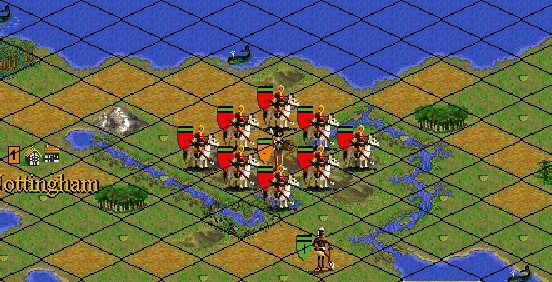
A hut 3 diagonals from a city would be at a distance of 4.5 which rounds down to 4 and thus is just outside of the barb-free zone.
In the attached capture, an English warrior has tipped a hut exactly three diagonals to the east of Nottingham for a very nasty outcome.
 Attachment: barbs.jpg Attachment: barbs.jpg
This has been downloaded 604 time(s).
|
|
| |
|
| |
|
|
|
LDiCesare
|
|
La Ferté sous Jouarre France
Jan 2001
time: 05:24
|
|
Brilliant.
The tech thingy explains why I so often get horseback riding where I only crave for ceremonial burial... I am sure that it could be used by some modders to give "interesting" outcomes of hut discoveries.
As for the terrain stuff, did anyone try to see if the chieftain-level advice has anything in common with the ai's placement of cities? In particular, does the ai look at all the city radius before determining whether it can settle or only the 8 surrounding squares, and do only the 8 squares affect the tribe/nomad outcome or the whole city radius?
|
|
| |
|
|
|
samson
|
|
ST - No problem, I appreciate your confirmation of the results.
SG - Thanks.
STYOM - Yeah, huts has been like the blindmen and the elephant ... everyone seems to have got hold of a different piece of it. There may yet be a few surprises left in there too. I'd like to figure out what kind of random number generator is at work.
As for the terrain thing, I agree with you: AI city site selection and the nomads/advanced tribe result is probably using the same algorithm. It seems to be food-production related.
LDiCesare - I have a number of plains/grassland huts that pop for nomads. And I've counted up the terrain in everyway I can think of, nothing concrete. Just a general feeling that low-food supply usually means nomads. I think you may be right that the Chieftain advisor is dispensing AI advice on the matter.
|
|
| |
|
|
|
solo
|
|
Lowell, MA USA
Jan 2001
time: 05:24
|
|
Samson,
This has made me look for the results I got when testing for tech frequency with no starting techs, which I will summarize below:
All tips were made from reloads using deity, raging and 2.42. I tried 3 types of terrain (grass,plains,forest), until I got 100 tech results from each (actually 104 from the forest huts). For each tech, I'll list the number of hits for each of these terrain types, followed by the total percentage for each tech using this 304 tech sample.
Pottery - 17,19,18 - 18%
Alphabet - 13,17,19 - 16%
Warrior Code - 20,20,27 - 22%
Horseback Riding - 29,24,25 - 26%
Bronze Working - 6,9,7 - 7%
Masonry - 15,10,7 - 10%
Ceremonial Burial - 0,1,1 - 1%
When these percentages are compared to your predictions using the gaps from the alphabetical list, there is a very strong correlation EXCEPT for Alphabet, where I was getting it twice as often. It could be my sample was not large enough, or it could be that the list does not wrap as you have suggested. However, tying frequencies to this list is valid and another great find!
It could be inferred from my results that terrain may play a minor role in tech selection, too. For example, Masonry appearing more often in open terrain.
One thing I remember from another test (I can not find the results), is that terrain seemed to be influencing the chances of the type of mercenary produced with open terrain favoring horses, chariots and other fast units, while rough terrain favoring archers and the like. Notice how the associated techs, Warrior Code and Horseback Riding, follow this trend a bit, too.
With terrain (open or rough) being a definite and determining factor for tribes and nomads, it would not surprise me to see it influencing techs and mercenaries a bit, too.
That's a great catch on the nomad frequency, tying it to the number of cities. I really had my doubts about the SP/MP theory as the cause behind this.
The few nomads I get from plains seem to come from spots where food is not abundant, spots never chosen by the game to found AI cities.
All of your other results look good to me! A well presented and very useful summary of what is known about huts, PLUS a few more new things to know about this game.
|
|
| |
|
|
|
samson
|
|
Solo,
Interesting data from your tests. In mine, Alphabet actually came up a bit light.
If the list doesn't wrap at the end, then Alphabet should be very hard to get, having only 1 tech in front of it. I assumed a wrap because Alphabet came up more often than predicted by a non-wrapping model. Also, I don't know if the User-Defined Techs and the Future Tech that appear in the Rules.txt list are used or not. So the total could be as low as 89, not 93.
I don't believe that terrain influences results in subtle ways. With techs, if the wrapping list model is correct, then it was probably used because it was easier to check an existing list of techs from a random point to find one with prerequisites than it would have been to build a list of only techs with prerequisites and then randomly select one. Given the gross effect of other factors that do effect hut outcomes, I tend to believe that subtle patterns are artifacts of small sample sets or caused by anomalies in the random-number generator. But hey, I could be wrong.
The 8 cities/nomad discovery was most satisfying. It explained the observations of two different sets of observers and resolved them. Neat.
SG, Dr Spike -- thanks.
|
|
| |
|
|
|
samson
|
|
STYOM -
The biggest boost in the ratios occurs when the Continent Rule applies. It gives an almost 50% chance of a Tribe outcome.
This suggests a strategy of attacking a new continent with a boatload of fast exploring units, locating and tipping huts on nomad-suited terrain, ferrying the nomads back to your home continent to found new cities while continuing to glean nomads from the new continent. Once that continent has had all its nomads plucked, move on to a third continent and use the nomads from it to found cities on the second continent. Etc.
|
|
| |
|
|
|
Six Thousand Year Old Man
|
 |
Ad Rock
Aug 2000
time: 00:24
|
|
quote:
Originally posted by samson
STYOM -
The biggest boost in the ratios occurs when the Continent Rule applies. It gives an almost 50% chance of a Tribe outcome.
This suggests a strategy of attacking a new continent with a boatload of fast exploring units, locating and tipping huts on nomad-suited terrain, ferrying the nomads back to your home continent to found new cities while continuing to glean nomads from the new continent. Once that continent has had all its nomads plucked, move on to a third continent and use the nomads from it to found cities on the second continent. Etc. |
I always sort of 'knew' that driving along the shore of a new continent with a ship full of explorers would yield a lot of nomads and tribes, just from experience. Come to think of it, though, I just thought the tribe numbers were unusual, not the nomads. Still, I didn't know the exact ratios, so that makes ratios like what you described, very valuable.
One wonders how many advanced tribes you could discover on an archipeligo map with lots of small islands. I assume there's no limit to the AT, unlike nomads (1/8 cities).
Open a hut in city safe radius - get a unit
Open a hut on new continent - get AT/nomad
Tactically, quite useful.
|
|
| |
|
|
|
Boco
|
 |
who was once King for a week.
Jan 2001
time: 00:24
|
|
I hesitate to post this FYI link, in case it's already obvious to the experts, but a good scenario designer, William Keenan, wrote a tip sheet that contains some information about goody huts and barbarians - unit types, influencing techs, etc. It can be found at:
Scenario League Barb Tech Tips.
Newer version at:
http://coc.apolyton.net/guides/barbarian_paper.shtml
Original version is a little old, so if you know of any inaccuracies or additional information, I'd be grateful to learn it.
Last edited by Boco on 06-12-2002 at 07:55
|
|
| |
|
|
|
samson
|
|
SG -
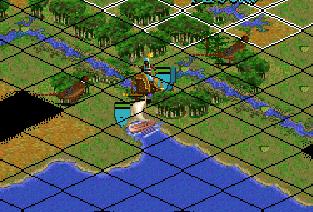
From your picture it looks like the hut square was a rivered Forest which would explain why it gave up a nomad. Tribes appear only on Grass or Plains. Can you confirm this as a Forest square? If it isn't, could you post the save?
DrSpike & STYOM -
Oedo years do not affect hut outcomes. If you still have the tests from your study, STYOM, please examine the conditions in light of the six rules above to see if they account for any skewed results.
Atawa -
The notion of terrain as a determiner of mercenary type is an attractive one, but unfortunately it is a myth.
Boco -
Thanks for the links. The Barbarian Paper is a good read. The only thing presented there that I would dispute is the notion that mercenaries from "Group A" and "Group B" occur in a 67% to 33% ratio. They do not. It is 50-50.
|
|
| |
All times are GMT. The time now is 05:24.
Apolyton Time is 00:24. |
top of page
|
|
|
Forum Rules:
You may not post new threads
You may not post replies
You may not post attachments
You may not edit your posts
|
HTML code is ON
vB code is ON
Smilies are ON
[IMG] code is ON
|
|
|
|
|
|






 05-12-2002 02:15





 I am sorry, I have read your post too fast. My results are exact to yours.
  Also I didn't realize that the barb-free area is defined by the distance from the city.
  Never in a million years would I have thought of that.




 |
|