|
| |
|

|
LTEC!
|
 |
...and ICE CREAM!
Feb 2000
time: 21:29
|
|
Not Brit, Czech.
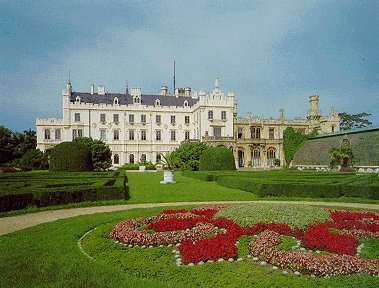
The Lednice Castle
Between Breclav, the Neo-Gothic chateau Lednice and Baroque residence in Valtice, lies a charming world of parks, gardens, ponds and forests, complemented by a number of small structures ranging from hunting lodges, chapels and colonnades, and up to the minaret and imitation castle ruins. The Lords of Liechtenstein, who were once the owners of the Lednice chateau estate, created the largest ever composed landscape area, rightfully listed in the UNESCO World Index of Cultural and Natural Heritage.
Although it has a long history behind it, the South Moravian castle of Lednice surrounded by an extensive English park, displays a typical architecture of the Romantic period.
The castle began as a fortress first mentioned in 1222, which occupied a strategic position in the frontier zone of the locale. In 1544 - 88 the stronghold was transformed into a Renaissance chateau with a garden by Hartman of Lichenstein. The late 17th century brought further alterations, including the enormous riding school and stables erected to the plans of Johann B. Fischer of Erlach. Evidently, it was their rise to the rank of Princes of the Empire that impelled the Lichensteins to undertake such ambitious works. In 1766 - 1822 the new classicizing tastes helped refashion the buildings.
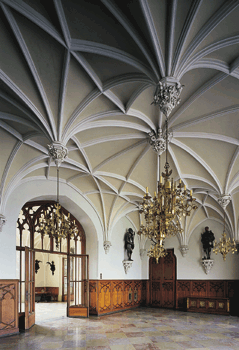
In 1815 the Empire style followed the designs of J. Kornhausel. However, not even this stage satisfied for long the Lichtenstein demands, which now turned to the neo-Gothic fashion. The new trend was imposed on the castle in 1846 - 58, first by the designs of Georg Wingelmüller and finally by Johann Heidrich. The interior also turned neo-Gothic, as we can see form the many halls enriched with carved wooden ceilings, staircases, and furniture.
The garden, too, underwent these changes of style. The last phase, dating from the 1840's, is the work of the architect, Fanti, and the botanist, Richard van der Schott, who transformed a flower garden "a la francais" into an English park of the Romantic period. Conceived in the grand manner, the park includes many structural features such as, for example, the cast - iron frame to the greenhouses built by the Englishman, P. H. Desvignes in 1843, the Temple of Apollo dating from 1817, the Romantic ruins of a castle built by Josef Hardmuth in 1807 and the Temple of the Three Graces dated 1825.
|
|
| |
|
|
|
Zylka
|
|
quote:
Originally posted by LTEC!
The Einsten Tower (Postdam) |
OH GOD NO - PUT IT BACK!!!
|
|
| |
|
|
|
Zylka
|
|
Oh wow, a bog. How does it smell, winner?
|
|
| |
|
|
|
Zylka
|
|
quote:
It smells like cat piss, because my mother and her cat hires one apartment of it and her cat does not like my cat. |
Your Mother's cat sounds like a real man in charge!
|
|
| |
|
|
|
Zylka
|
|
Oerdin, I'm of taste that Gaudi's designs are absolutely gorgeous (keep in mind I've spent countless psilocybin fueled weekends staring at the stipled ceiling's ornate dancing games)
As for FLR... I don't think I'll ever understad him or his designs. In fact I don't think they were meant to be "understood" by true genius. The guy was boring and off the mark, at best
|
|
| |
All times are GMT. The time now is 05:29.
Apolyton Time is 00:29. |
top of page
|
| archivepost |
|
Forum Rules:
You may not post new threads
You may not post replies
You may not post attachments
You may not edit your posts
|
HTML code is ON
vB code is ON
Smilies are ON
[IMG] code is ON
|
|
|
|
|
|






 30-07-2003 21:29


 Attachment:
  Attachment:


 |
|