|

|
HershOstropoler
|
|
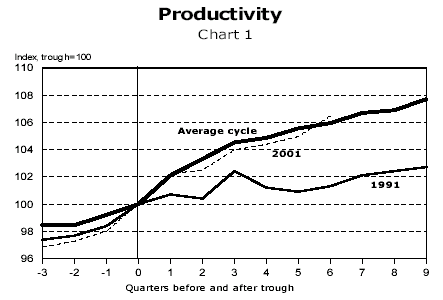
I suppose we'll see some inventory effects in q3 and q4, so the whole thing might look good on paper.
The really interesting question will be where the US economy is once it has rebealanced, ie a return to normal interest rate levels, a budget deficit of maybe 2-3 % and a balanced foreign account.
|
|
| |
|
| |
|
|
|
el freako
|
 |
Bristol, European Union
Oct 1999
time: 05:30
|
|
quote:
Originally posted by DanS
The internet is a very useful tool. Here's an article by Robert J. Gordon in 2001 saying that it was a certainty that productivity growth would decline in the next couple of years. In pertinent part...
Yet in 2002 we had the best productivity gains since '50...
|
Well, using the GDP per man-hour across the whole economy measure of productivity growth, and bearing in mind that he said that before any data for 2001 was in...
Growth in US GDP per man-hour, whole economy:
2002: 3.1%
2001: 0.9%
1996-2000: 2.3%
So 2001 looked pretty bad and the rapid productivity growth in 2002 was just the catchup from that.
Last edited by el freako on 14-08-2003 at 05:10
|
|
| |
|
| |
|
|
|
DanS
|
 |
Kickball Capital of the World
Jan 1970
time: 00:30
|
|
OK, is Robert Gordon changing his tune? He seems like he's turning into a new economy Euro-basher weenie. 
In FT...
quote:
America wins with a supermarket sweep
By Robert Gordon
Published: August 19 2003 20:06 | Last Updated: August 19 2003 20:06
Growth in output per hour, better known as productivity, is the life blood of economic progress. It makes an enormous difference whether productivity grows at 3 per cent or 1 per cent a year, with the higher number implying a doubling of society's average standard of living in a single generation and the lower number implying that it will take three generations for the same doubling to occur.
For most of the period since 1970, the US was in the back seat, with its productivity growth chugging along at a mere 1.4 per cent a year, while Europe grew at well above 2 per cent. But starting in 1995 something extraordinary happened. America's productivity growth speeded up while Europe's slowed. A host of research studies attributed most, if not all, of the US's surge to its dominance in making computers and developing software. Intel and Microsoft are familiar names that symbolise US dominance in the information and communications technology (ICT) sector.
But this alleged superiority of the US in ICT raises a host of puzzles. Intel and Microsoft make chips and software in Ireland and elsewhere in Europe, and in many branches of ICT Europeans compete vigorously. And what about the "C" in ICT? Everyone knows that Europe is far ahead in mobile phones and outfoxed the US early on by adopting a common GSM standard, while Americans were hobbled by a patchwork of incompatible standards. Two of the three big names in worldwide mobile telephony are Ericsson and Nokia, after all.
Two weeks ago the productivity puzzle suddenly deepened when the US government revised upwards its productivity numbers for the past two years and provided its first release for the second quarter of 2003, which came in at an unbelievable 5.7 per cent. The underlying long-run trend of productivity growth is currently running at about 2.8 per cent a year, fully double the pre-1995 growth rate.
So we face a new paradox. Those research studies that attributed the 1995-2000 revival of US productivity growth to the ICT investment boom of the late 1990s have some explaining to do. After 2000, the ICT investment boom collapsed along with the stock market but productivity growth accelerated. If ICT growth collapsed but productivity growth increased ever faster, something else besides ICT investment must have been behind the American miracle.
Part of the answer is that the research studies are flawed. Somewhat unbelievably, they assume that a piece of computer hardware or software had its full impact on productivity the day it was produced, back in 1998 or 1999, before it was even delivered to the user. But almost all of us took a long time to learn how to use the hardware and especially the software. Who among us can claim to have been as proficient at using Microsoft Word, Excel and PowerPoint on our first day as we are today after long and painful learning? So the studies exaggerate the benefits of ICT investment during the boom years of the late 1990s and understate the delayed benefits in the new century.
Another, related answer has been suggested by Shinkyu Yang and Erik Brynjolfsson, the Massachusetts Institute of Technology economists. They view ICT investment as an iceberg, with a visible part that is measured by the government but a hidden part under water consisting of "intangible" productivity-yielding activities. These comprise such things as reorganising and reinventing business practices, and both formal and informal training of computer and software users. During the late 1990s, both parts of the iceberg were growing rapidly and hordes of programmers, consultants and trainers were hired to produce the hidden intangibles. Productivity growth - that is, output per hour - was understated because the output numerator was missing the intangibles, while the denominator included all those hours of work devoted to producing the intangibles.
Then, after the ICT boom collapsed, the tables turned. All that valuable intangible investment was in place and it helped companies to produce ever more output with fewer production workers. On top of that the hordes of programmers, consultants and trainers were fired and are now walking the streets in search of jobs. So output has been growing while employment has been shrinking, producing the explosion of productivity growth that we observe in the American data.
Where does Europe fit in? The data show that Europe's performance is worst in those industries that are heavy users of ICT, especially retail trade, which just happens to be where the US's productivity showing is strongest. America's retail productivity performance has all been achieved in stores newly built since 1990, not in existing stores.
The new stores are the "big boxes" such as Wal-Mart, Home Depot and Best Buy, large new buildings set up on greenfield sites at interstate highway junctions, in suburbs and, increasingly, in inner cities. As these new stores reap the rewards of their size, openness and accessibility and drive smaller stores out of business, they bolster the average productivity of the US retail sector as a whole.
While countries differ, Europe has many ways of stifling modern retailing, from green belts and land-use restrictions to laws that prevent companies from lowering their prices. These make life difficult for new, more efficient retailers in order to protect small, traditional merchants. This is one of many cultural chasms across the Atlantic. Many Europeans could not care less about retail productivity and instead are adamant that Europe must avoid the US's unregulated land use and starvation of public transport, which have produced its overly dispersed, energy-wasting metropolitan areas.
Europeans spent most of the postwar era catching up with the US; and indeed a number of European nations have exceeded the level of the US's productivity. But if the recent disparity in growth rates continues, Europe will sink back steadily and will be forced to ask how long it can afford to protect the old and ignore the new. |
|
|
| |
|
| |
|
| |
|
|
|
The Vagabond
|
 |
of realpolitik and counterpropaganda
Jan 1970
time: 05:30
|
|
quote:
Originally posted by DanS
Ireland has been rising for a good while now. I like to see it, since they have had very hard economic times for centuries. ef's adjusted GDP per head figures put Ireland even higher than does the CIA. It's quite possible that Ireland will surpass the US in GDP per head in the next couple of years.
|
Yeah, they should have been growing at quite a pace recently, for I surely remember that they used to be included in the same group with Spain, Greece and Portugal perhaps just five or seven years ago. Hell, they have even appreciably surpassed the UK itself! So their reliance on high-tech paid off. Perhaps the American Irish will soon be heading back en masse to their motherland.
quote:
Re productivity, yes the add'l hours that Americans work is fairly well known, and it is baked into the cake. I don't know where the output per hour numbers stand right now US v. Europe, but a couple of years ago those were about even for several of the bigger European economies. Maybe the US is ahead slightly now after the last couple of years.
|
So, basically, the GDP per capita difference between the US and the old Europe is due to the additional hours that Americans work...
quote:
Re Russia, it has a lot of potential, if a couple of things are cleaned up.  However, CIA appears to be using different PPP's than others, giving Russia a couple thousand $ boost. However, CIA appears to be using different PPP's than others, giving Russia a couple thousand $ boost. |
I hope they'll be cleaned up. I expected the number to be around $8,000, but the table gives $9,300. CIA has always tended to overestimate Russia, be it in the Soviet times or now. 
|
|
| |
|
| |
|
| |
|
| |
|
|
|
el freako
|
|
Bristol, European Union
Oct 1999
time: 05:30
|
|
quote:
Originally posted by DanS
Ireland has been rising for a good while now. I like to see it, since they have had very hard economic times for centuries. ef's adjusted GDP per head figures put Ireland even higher than does the CIA. It's quite possible that Ireland will surpass the US in GDP per head in the next couple of years. |
Yes, but it won't be richer.
You see GDP is an easy measure of production but not of income.
Gross National Income (the new name for GNP) is the best measure for this, basically this is GDP plus the difference in net payments (mostly by foreign companies) - in most countries GDP and GNI are almost the same with less than a 2% difference.
But Ireland, with it's massive influx of foreign companies, sends out far more payments than it recieves.
It's GNI was the same as GDP in 1980, 8% less in 1990 and 15% less in 2000.
Last edited by el freako on 05-09-2003 at 09:46
|
|
| |
|
|
|
el freako
|
|
Bristol, European Union
Oct 1999
time: 05:30
|
|
Everyone be aware that that is non-farm, business productivity - not that pertaining to the whole economy.
Using GDP/Employment then productivity went up by 2.5% at an annual rate in Q2 following an annualized fall of 0.8% in Q1. Productivity was 1.5% higher in Q2 2003 than Q2 2002.
Last edited by el freako on 05-09-2003 at 11:01
|
|
| |
|
|
|
HershOstropoler
|
|
So we are in the new new economy, where low investment levels create record productivity growth.
|
|
| |
All times are GMT. The time now is 05:30.
Apolyton Time is 00:30. |
top of page
|
| archivepost |
|
Forum Rules:
You may not post new threads
You may not post replies
You may not post attachments
You may not edit your posts
|
HTML code is ON
vB code is ON
Smilies are ON
[IMG] code is ON
|
|
|
|
|
|





 08-08-2003 20:27


 Attachment:

 Saras,
 (next only to Norway, and I don't count artificial paradises like Luxembourg).




 |
|