|
| |
|

|
DanS
|
 |
Kickball Capital of the World
Jan 1970
time: 00:30
|
|
It's been some months since there was a post to the last GDP thread, so I thought I would start another. The last one is at...
http://apolyton.net/forums/showthre...&threadid=74146
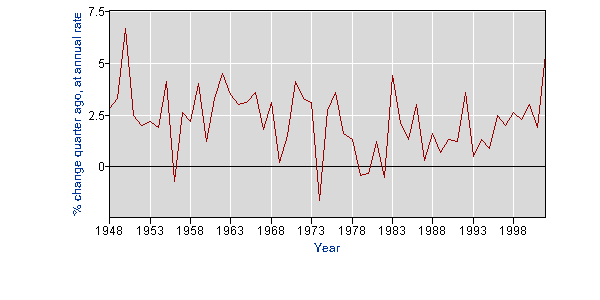
New US productivity numbers show some stunning productivity gains for final '02 (5.4%, the best since 1950) and excellent productivity in Q1 and Q2 (2.1% and 5.7%, respectively). Bring out the champagne!
Here's an FT article about it...
quote:
US labour market and productivity improve
By John Labate in New York
Published: August 7 2003 14:19 | Last Updated: August 7 2003 15:23
The US employment sector continued to show signs of improvement, while productivity in the second quarter rose sharply, according to official reports released early Thursday.
Initial claims for benefits fell to 390,000 last week, down by 3,000 from a revised figure of 393,000 for the prior week, according to a report by the US Department of Labor.
More importantly to economists, the four-week moving average of claims fell to 397,250, the first time it has been below the 400,000 mark since mid-February. The four-week average is considered crucial since it tends to level out volatility in what can be an erratic weekly report. All figures are seasonally adjusted.
In a separate report, US nonfarm productivity surged 5.7 per cent in the second quarter, up from 2.1 per cent in the first quarter, according to the US Bureau of Labor Statistics. It was the highest productivity rise since the third quarter of last year and shows that in the face of a sluggish job market, output per employees continue to rise.
Unit labour costs fell 2.1 per cent for the quarter, well below analyst expectations. Labour costs account for about 60 per cent of total costs and with costs falling and productivity rising sharply, US corporate margins are expected to get a boost. Hourly compensation rise 3.5 per cent.
In a revision to last year's figures, the BLS report also noted that average annual nonfarm productivity rose 5.4 per cent during the four quarters of 2002, the sharpest rise since 1950. |
Attached is the BLS historic graph...
Series Id: PRS85006092
Duration: % change quarter ago, at annual rate
Measure: Output Per Hour
Sector: Nonfarm Business
 Attachment: prs85006092_59407_1060278297199.gif Attachment: prs85006092_59407_1060278297199.gif
This has been downloaded 194 time(s).
|
|
| |
|
|
|
Ecthy
|
|
Zhonghuà Rénmín Gònghéguó
Mar 2000
time: 06:30
|
|
so what's the current GDP ranking of countries?
|
|
| |
|
|
|
HershOstropoler
|
|
Bubbele duh, bubbele dih...
|
|
| |
|
|
|
HershOstropoler
|
|
Until the next revisions.
|
|
| |
|
|
|
HershOstropoler
|
|
AFAIK they one revised the hours data. The output revisions based on BEA data should have yet to come.
|
|
| |
|
|
|
Adam Smith
|
 |
Maryland, USA
Jan 1970
time: 00:30
|
|
Well lookee here...the GDP thread...
A couple weeks ago I heard Robert J. Gordon argue that the productivity gain is bogus. As interest rates fall, the implicit price of owner-occupied housing falls, taking the GDP deflator with it. This means that less of the change in nominal GDP is attributed to price changes, and more to output changes. Real income goes up, because housing prices fell, but the actual amount of output per worker remains unchanged. Gordon argued that this phenomenon is responsible for much of the growth in measured US productivity recently and in the 1960's, and that the same process, run in reverse, is responsible for much of the decline in measured US productivity in the 1970's. He also mentioned a couple of similar factors, such as inappropriate price measurement for apparel, but I will have to find the details in my notes.
|
|
| |
|
|
|
HershOstropoler
|
|
AS:
"Real income goes up, because housing prices fell"
You mean the cost of housing, not house prices, or?
Rents are related to real rates. Another factor is the housing bubble that crowds out renting in favour of ownership and depresses rents.
There's a couple other questionables. Business output growth has surpassed GDP growth for a long time; the fall in hours looks pretty big; the problem of measuring service prices deflators; and our old friend, hedonic deflators.
|
|
| |
|
|
|
Ecthy
|
|
Zhonghuà Rénmín Gònghéguó
Mar 2000
time: 06:30
|
|
the real question is if China and India have overtaken Germany or not.
I think it depends on exchange course development or how you rate it respectively. Somewhat.
|
|
| |
|
|
|
HershOstropoler
|
|
Broken record: house prices are a bubble. rising interest rates will pop it.
|
|
| |
|
|
|
HershOstropoler
|
|
Ok, what's your opinion on:
Totalfina
EON
Daimler
RWE
Suez
|
|
| |
|
|
|
HershOstropoler
|
|
So what should I buy in Vilnius after the next wall street crash?
|
|
| |
|
|
|
HershOstropoler
|
|
I still don't own any stocks. When I start buying, I'll look for low valuations.
And I always write naked calls. You should know that by now.
|
|
| |
|
|
|
HershOstropoler
|
|
True, and I confused that with posting naked anyway.
|
|
| |
All times are GMT. The time now is 05:30.
Apolyton Time is 00:30. |
top of page
|
| archivepost |
|
Forum Rules:
You may not post new threads
You may not post replies
You may not post attachments
You may not edit your posts
|
HTML code is ON
vB code is ON
Smilies are ON
[IMG] code is ON
|
|
|
|
|
|






 07-08-2003 22:46


 ?
?

 |
|