|
| |
|

|
Alinestra Covelia
|
 |
I sense the dodgy presence of Bing - a presence I've not felt since...
Feb 2000
time: 00:32
|
|
Well, the commune system was dismantled even as early as 1987, when Deng declared the old system a failure. State owned companies are currently deregulating at a fairly steady pace (recently, the central government even issued statements that it would no longer fund more than two newspapers per province - many of my fellow journalists from the mainland say this is going to be the thin end of the wedge for long term political press freedom).
The central government does have a fear that over reliance on market forces could lead to wrenching destabilization. In any case, any such changes would be much more gradual than anything seen in Taiwan. When you're dealing with such a large populace and so underdeveloped a sprawling hinterland, speed is not always your top priority.
As for Taiwanese independence, the average Chinese thinker tends to be very clear that Taiwan is a part of China. How far this owes itself to government propaganda is doubtful, but many of my former classmates at Qinghua felt that eventual peaceful reunification was inevitable, so long as the economic and cultural similarities could overcome the political differences.
It would be nice if mainland China could liberalize to match the freedoms in Taiwan. To do this, we'd need a leadership level commitment to liberalization, as well as a leadership that can nonetheless apply checks to the process to keep it from causing too great a social rift between haves and have-nots.
Currently, one view is that China's current leadership is concerned only with self-service and self-preservation. I have no intention of defending them from the accusation.
But I also feel (as do many members of my father's family - Taiwanese born and bred) that the politicians who stand up and renounce all ties with the mainland do so with no regard for the historical, cultural, and familial ties between the two. My grandfather had a Taiwanese passport - all his siblings stayed behind and have Chinese passports. They never considered themselves separate countrymen. Go back two generations, and there is no difference at all, political or national.
A politician who severs his people from their cultural and historical background, ostensibly in their name, is just as guilty of playing to the political gallery as the mainland's bureaucrats. A declaration of independence would effectively end association with China's cultural heritage. My cousins have never been Communists, but they're all very clear that they're Chinese - albeit residing in Taiwan.
Hopefully, China's industrialization can lead to political loosening and stability, such that autonomy (in Tibet and Hong Kong) becomes real in deed rather than just a catchphrase. My father is not happy with having one half of the family in Zhejiang Province in China, and the other in Taipei and Taichung, never to see each other. He says he hopes for a situation where Taiwan reunifies with China, and the mainland will have developed to the point where everything actually stays the same.
It's important to remember that while there may be plenty of drawbacks to being a Communist, there's nothing wrong with being Chinese.
Looking at some of the posts here, it's evidently an easy thing to miss.
Last edited by Alinestra Covelia on 30-11-2003 at 03:21
|
|
| |
|
|
|
shawnmmcc
|
|
Some corrections -
quote:
from Nationmaster.com: The Republic of China has a population of 22.2 million. More than 18 million, the "native" Taiwanese are descendants of Chinese who migrated from Fujian and Guangdong Provinces on the mainland, primarily in the 18th and 19th centuries. The "Mainlanders", who arrived on Taiwan after 1945, came from all parts of Mainland China. About 370,000 Taiwanese aborigines inhabit the mountainous central and eastern parts of the island and are believed to be of Malayo-Polynesian origin. |
Taiwan has it's own indigenous Chinese who emigrated two plus centuries ago. They consider themselves their own culture, albeit related to China. Chiang Kai-Shek brought the remnents of his dictatorship there and established a nice little authoritarian government. Chen is Taiwanese, and if I remember correctly campaigned in part over just this issue. Taiwan has now become a democracy, with the majority more-or-less indigenous Taiwanese population now having their own government. (the real Taiwanes that are largely confined to the mountains, have minimal rights like most displaced minority indigenous peoples).
Militarily, China might be able to take Taiwan, but the resulting victory would devastate it's military. A missle bombardment would do some damage, but as the Nazis found out, ballistic unguided, or modern semi-guided, missles without WMD warheads do no real military damage. Kill a few civilians, but that typically only increases the support for the goverment that is attacked.
Aviation wise, PRC would have some real problems.
http://idun.its.adfa.edu.au/ADSC/Air/Air_paper_Ji.htm
The Taiwanese aircraft include 60 Mirages ( I cannot remember which model), 150 F-16's, 130 IDF (excellent locally grown air defense fighter), plus some F-5E's still in service. Please note this is mostly from memory, and I don't have a current Jane's as I cannot afford the subscription.
PRC has the aircraft to take these out, but it would be hideously expensive at this time. China would lose at least half, probably more than 80% of it's aviation assets. They have enough aircraft to "human wave" the Taiwanese air defenses, i.e. make the airborne aircraft run out of missles and still have enough aircraft to multi-team the Taiwanese aircraft. Hideously expensive, but workable if you are honest about your aviation capability. The last country I saw that was honest about taking massive losses like that was the Soviet Union in WW2. Any "believe our own propoganda" thoughts could actually lead to the PRC losing the air war, feeding in its air force piecemeal.
However, we just had the case of illegal export of aviation electronics by a Chinese ex-pat ex-human rights type in the US, you have Chinese imports of both air frames and electronics from the Soviet Union, etc. Sometime within the next decade there could be a "sweet spot" for the PRC, when they have superior aircraft and the US has not sold it's newer technology to Taiwan. Taiwan will still probably have overall electronic superiority, but it will be much smaller, lethally so for Taiwan if a conflict ensued.
The PRC has the assets to invade Taiwan if it has air superiority. Taiwan has a nasty small anti-shipping missle, jointly produced with Israel using an enlarged warhead. It's designed to kill small ships, which is what almost all the PRC navy consists of. The PRC would take hideous losses. However, with air superiority they can afford to. The Taiwanese navy would have trouble surviving a conflict, as the PRC has been upgrading and expanding it's submarine fleet as well as it's larger small ships, like destroyers and frigates. The PRC has been purchasing eletronics and ASW equipement from Europe, and has the ability to again inflict defeat on the Taiwanese navy. Just like the air war, the resulting losses would be terrible.
Whether the PRC would have the amphibious assets to succeed after taking the requisite aviation and ship losses is problematic, again based on essentially an honest U.S. Grant type strategy, i.e. let's play meat-grinder. Done from the outset, it can be very effective. However, you cannot play half-measures with this type of strategy.
The more important question is whether the leadership that ordered this blood-letting would survive in power. Look at my signature below. 'Nuf said. As long as there are factions in the PRC leadership, and there is enough balance-of-power that the leader(s) ordering this kind of attack could be kicked out during the next party congress, it won't happen. But if any one group gains total ascendency within the party aparatus, then this scenario vastly increases in possibilty.
One other factor that mitigates against this is the claim-jumping of oil reserves by the PRC in the area of the Spratly Islands. The PRC claim is based on another disputed claim, in this case of an island off the coast of Vietnam, which itself is disputed. The claim is very shakey, the forces backing it are not. However, once it lost most of its navy, the other nations involved in the dispute - Malaysia, Philippines, Vietnam, and Brunei (Taiwan is also, but for obvious reasons is discounted given a war with the PRC) - would have the forces to reassert their claims. I have seen reports that this is possibly the largest new offshore field since the North Sea, and again with the PRC's growing hunger for oil, it makes the chance of a military conflict with Taiwan decrease.
In summation, a unified communist party (which means NO internal divisions, which hasn't been the case since Mao) that sees retaining Taiwan as an integral part of the PRC can and will resort to force if it so chooses, and will win. It will also take terrible losses, and could lose oil assets. This doesn't even begin to count the economic disaster that would ensue for the PRC, which other posters have addressed. Could it happen? Yes. Will it happen? Probably not, I agree with most of the posters here. However, that is the problem with totalitarian governments. Once the cadre of people in control gets small enough, they can make decisions that look stupid to the rest of us. I could make a domestic comparison, but that would be trolling. 
|
|
| |
|
|
|
mindseye
|
 |
A Yankee living in Shanghai
Apr 1999
time: 13:32
|
|
quote:
Originally posted by Plato
Additionally, it appears that the mainland will not make the necessary concessions to freedom necessary for the reunification to be anything beneficial to Taiwan other than not being attacked. |
I don’t see that at all. As Ali noted, the gov't here is in a state of steady transformation, most of it positive. Just look at the case of Hong Kong. While there have been problems since the handover, Hong Kong has not been turned into a police state.
quote:
Originally posted by Ned
On communism vs. fascism in China, it would be interesting to see just how much of the economy continued to state owned and planned. Also, do their farmers exist only in communes, etc. |
About two years ago the 50% line was crossed, i.e. the private economy contributed more to GDP than SOEs - and the rate of privatization just keeps accelerating and accelerating ... It's endlessly fascinating to watch free market capitalism bloom here in all its manifestations, from mammoth corporations to neighborhood shops. Simply amazing to behold at the speed with which it's progressing!
As for communes, jeez Ned ... have you heard that Chairman Mao has died? 
quote:
Ali, does China have independent corporations that can make what they choose, sell it for unregulated prices, make as much profit as it can, and distribute dividends to its stockholders? |
Yes, in fact there's a stock exchange right here in Shanghai! The amount of gov't interference depends on the industry. For instance, a private publishing house has to walk a fine and constantly changing line that a publicly-traded disposable-diaper manufacturer would never have to deal with. For most corporations, I think official corruption is a far larger problem than any kind of official interference. Most gov't officials want to grow, grow, grow their burgeoning local private sectors - not restrict them!
Questions like this remind me of how dated many westerners' views of China are. Some contemporary indicators of urban life in China (lead by Shanghai):
Gone: rickshaws, Mao suits, sidewalk dentists, communes, little red books, people calling each other "comrade", backyard iron smelts
Happening: private auto ownership, pizza, home broadband internet access, personal satellite dishes (latest ad under my door promised, among other things, the Playboy channel), cool electric scooters, tattoos, gay pin-up magazines at public newsstands  , and the latest: just found a bong shop in Shanghai , and the latest: just found a bong shop in Shanghai 
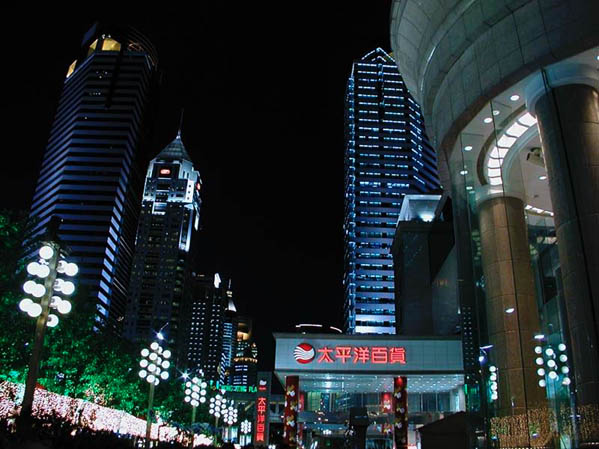
Where the communes once stood:
 Attachment: shanghai15a.jpg Attachment: shanghai15a.jpg
This has been downloaded 34 time(s).
|
|
| |
All times are GMT. The time now is 05:32.
Apolyton Time is 00:32. |
top of page
|
| archivepost |
|
Forum Rules:
You may not post new threads
You may not post replies
You may not post attachments
You may not edit your posts
|
HTML code is ON
vB code is ON
Smilies are ON
[IMG] code is ON
|
|
|
|
|
|






 29-11-2003 13:03








 |
|