|
| |
|

|
nbarclay
|
 |
Huntsville, Alabama
Dec 1999
time: 23:35
|
|
In 1390, the Celts pulled a doublecross and used a Right of Passage agreement to send a band of guerillas all the way to the undefended city of Knossos. Rome promptly retook the city and killed every Celtic guerilla in sight, capturing a band of Celtic workers. More importantly, Rome allied the entire world against the Celts, aiming for their destruction (which, in turn, would provide access to furs, the last luxury that Rome did not yet have).
[I'm starting to seriously consider seeing whether a domination victory will be possible without ever capturing a single city from an AI except for retaking cities an AI took from me. With another city founded in 1395, I'm up to 40% of the world's land area. If I can get the AIs to kill each other off and slip in Roman cities in between, domination may be possible - although I may have to use a strange kind of ROP rape to plant the last cities I need.]
|
|
| |
|
|
|
nbarclay
|
|
Huntsville, Alabama
Dec 1999
time: 23:35
|
|
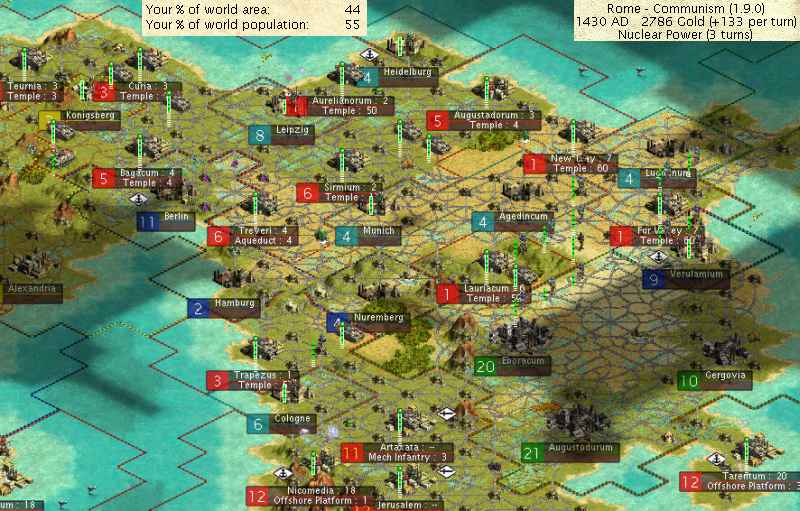
By the year 1430, Persia had taken four cities from the Celts, Babylon had taken three, and Egypt managed to take one. Roman settlers with a heavy Mechanized Infantry escort followed in the wake of the rival military forces and founded three cities in former Celtic lands. With the founding of the cities of New Troy and Fur Valley, the fur supplies that had once belonged to the Celts were in Roman hands. Rome now had domestic supplies of all eight luxuries.
In regard to the research situation, Computers took six turns, Rocketry five, and Miniaturization six. The Internet was completed using a palace prebuild the same turn Miniaturization was researched, and that put Rome on a four-turn research pace. The only real obstacle to maintaining that pace would be whether or not sufficient financing could be maintained from Rome's neighbors. Much of Rome's gold hoarde had been spent upgrading infantry and guerillas to Mechanized Infantry and TOW Infantry, so there was a limit to how long Rome could maintain its research pace without significant foreign income.
 Attachment: ad 1430 furs captured.jpg Attachment: ad 1430 furs captured.jpg
This has been downloaded 104 time(s).
|
|
| |
|
| |
|
| |
|
|
|
nbarclay
|
|
Huntsville, Alabama
Dec 1999
time: 23:35
|
|
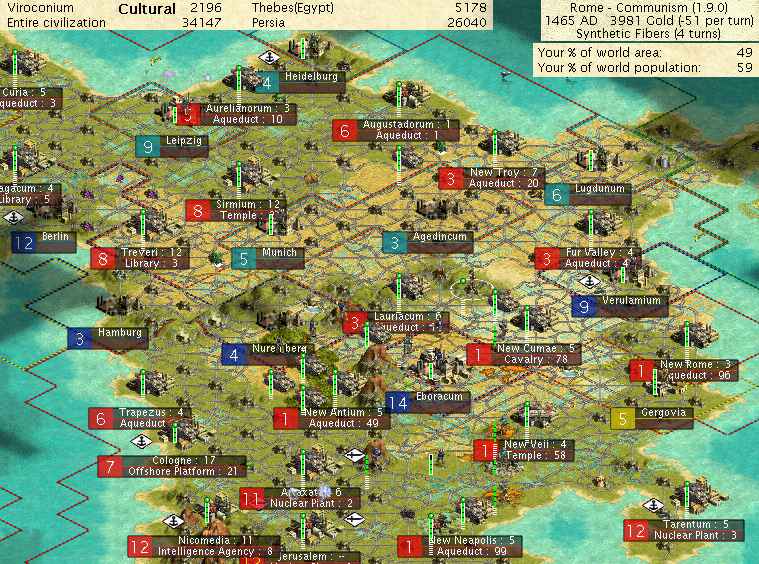
In 1635, Babylon finished conquering Egypt. Caesar and his council then started considering whether to ally with Persia against Babylon or with Babylon against Persia.
On one hand, the situation had reached a point where Babylon actually had a larger population than Persia. Further, Babylon's communist regime could make good use of its territory. And the fact that Babylon had won the greater number of cities in the wars with the Celts and especially with Egypt argued that Babylon could be the stronger ally.
But while that was true, Caesar also had it within his power to ensure that Babylon would be a relatively weak enemy. Babylon's two sources of rubber and one of oil were all adjacent to Rome's borders where they could be pillaged easily - and where any workers that tried to reconnect them could be captured. Babylon's advantage over Persia in control of luxuries could also be dealt with through appropriate pillaging.
Finally, there was some geographic advantage involved in allying with Persia against Babylon rather than vice versa. Most of Persia's cities had enough cultural depth for Babylonian forces approaching Persia to be vulnerable to counterattack. But Persian tanks could strike at numerous Babylonian cities without warning, including not only the isolated cities but also core cities where Rome had founded cities just on the Egyptian side of the former Egyptian-Babylonian border. With a little luck, Babylon could be defeated in detail by Persian forces achieving local superiority.
And finally, there was the worker situation. Babylon had around twenty workers, some native and some slaves, working along the border between Babylon and Rome. By choosing Babylon as his target, Caesar could add to his already extensive collection of slaves.
After weighing those issues, Caesar decided to make Babylon his target. Radar artillery and artillery pounded the Babylonian forces that had not yet returned to their cities after defeating Egypt, including a 2-tank, 1-infantry army. Modern armor and an old elite tank unit moved in to finish off the enemy forces, finally gaining Rome its first great leader. The only Roman losses of the initial operation were a single modern armor unit that lost to a mechanized infantry force that was defending the Babylonian army.
|
|
| |
|
|
|
nbarclay
|
|
Huntsville, Alabama
Dec 1999
time: 23:35
|
|
quote:
Originally posted by vmxa1
In the modern age, I do not see a need for lots of arty. They only slow down the armies I will be using to smash into cities. |
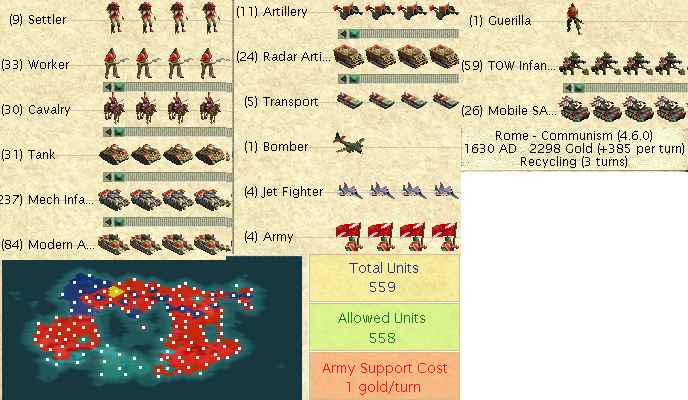
Radar artillery can bombard anything Modern Armor can attack: move one and bombard two, versus move three. Only MA armies (and armies of older 3-move units) can outrun the reach of radar artillery, and even then, radar artillery can support them more often than not. The RA/MA combination is a very powerful one.
But remember that I'm not attacking cities in this game. So my force mix is heavily overbalanced toward defensive rather than offensive units. The only thing my bombardment forces are normally needed for is to weaken any enemy units that try to enter my territory before I use tanks or MAs to dispatch them.
quote:
A dozen is enough to move around on rails to do damage to shipping or attackers. Anyway you tend to capture a few here and there. |
In the AU Mod, we told the AIs not to build artillery-type units because when it does, human players usually seem to get more use out of them than the AIs do. (Actually, AIs probably get some decent use out of them at times defending against other AIs, but against a good human player, they usually just get one shot before they're captured.)
|
|
| |
|
|
|
nbarclay
|
|
Huntsville, Alabama
Dec 1999
time: 23:35
|
|
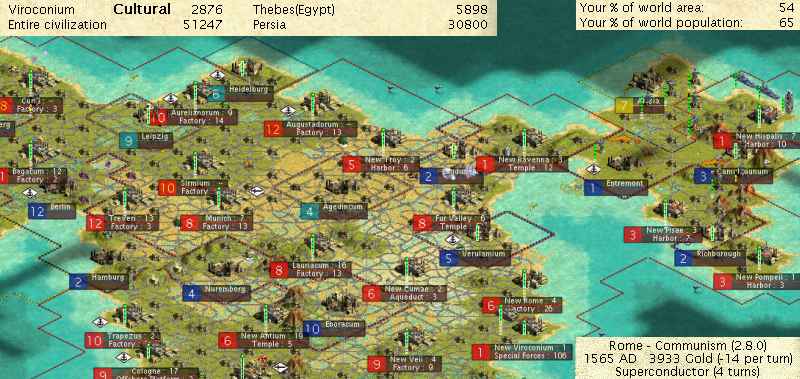
The endgame was a bit anticlimactic. During the war between Persia and Babylon, I was not inclined to try to squeeze cities into Babylonian territory, mostly because I wasn't in a hurry to win under conditions that would leave the new Roman cities culturally crowded and isolated. As time went on, a couple more towns that were horribly crowded by Roman culture decided to join the Roman Empire.
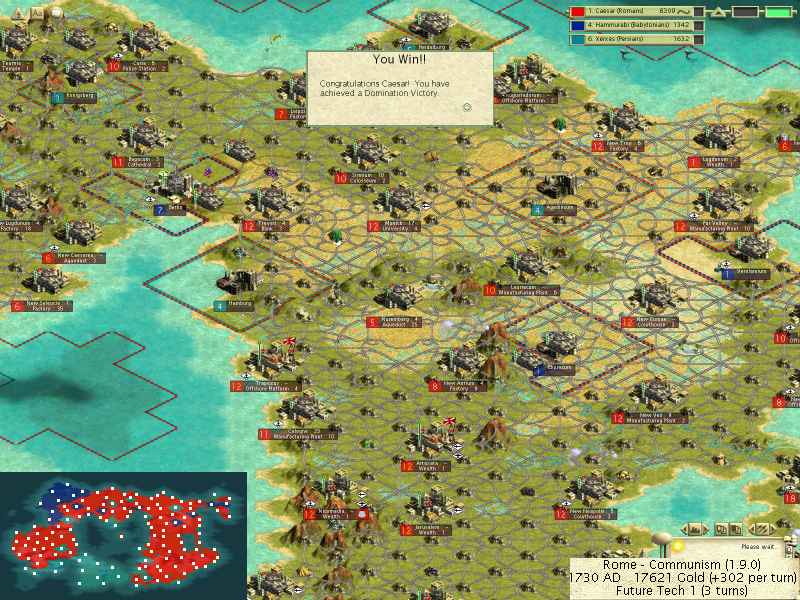
Then, as the year turned over to AD 1730, two events conspired to bring victory. Persia conquered a core Babylonian city along the former Babylonian-Greek border, allowing Roman borders to expand a little, and the former Germanic city of Nuremburg with its nine tiles flipped.
Due to how long it took to win by domination without attacking AI cities myself, I actually researched through the entire tech tree for the first time ever. I got to have some fun with stealth bombers, first building them to destroy the Babylonian navy (which was seriously annoying me by futilly bombarding me and retreating into a city turn after turn) and then using them to destroy invading Babylonian land units.
There was one oddity regarding the tech picture: I actually had to go back and research Free Artistry myself as my next-to-last tech (the last being Advanced Flight) before I could move on and start researching Future Tech 1. The research effort required for Free Artistry was one turn at twenty percent and three at ten percent - the equivalent of half of a single turn's potential research output. I had just started on Future Tech 1 when the game ended.
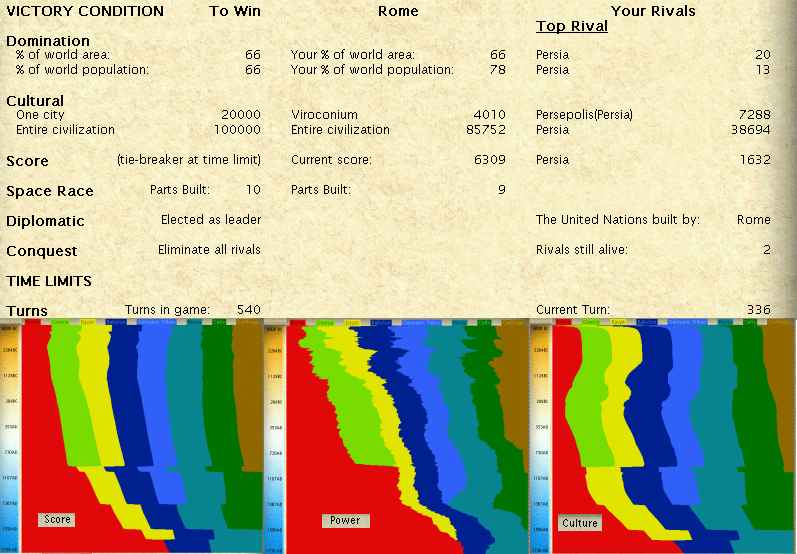
Playing out the game for domination in this fashion has proven to be an interesting exercise in the manipulation of AIs. I doubt that I'll ever do it again because of how much time is involved, but it is an interesting thing to have done once.
Attachment: ad 1730 victory.jpg
This has been downloaded 60 time(s).
|
|
| |
All times are GMT. The time now is 05:35.
Apolyton Time is 00:35. |
top of page
|
|
|
Forum Rules:
You may not post new threads
You may not post replies
You may not post attachments
You may not edit your posts
|
HTML code is ON
vB code is ON
Smilies are ON
[IMG] code is ON
|
|
|
|
|
|





 19-08-2004 19:13







 |
|