|

|
Maquiladora
|
|
Fray Bentos '35
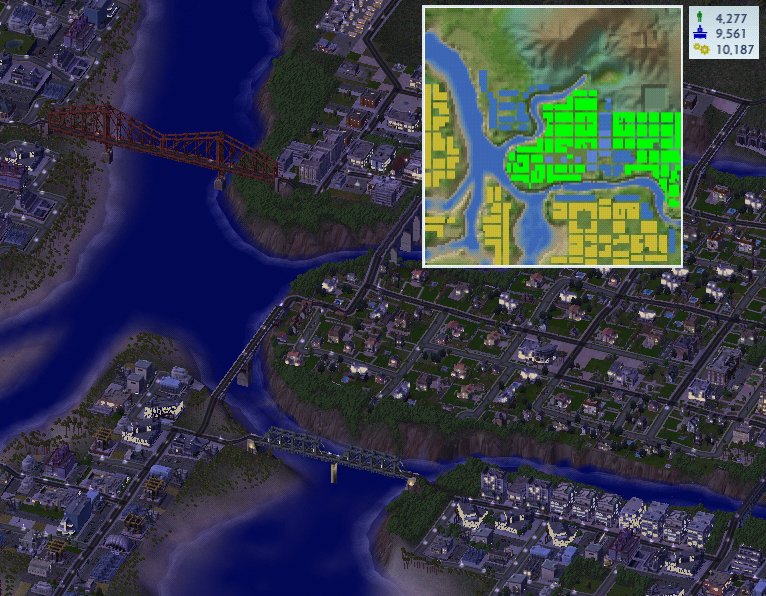
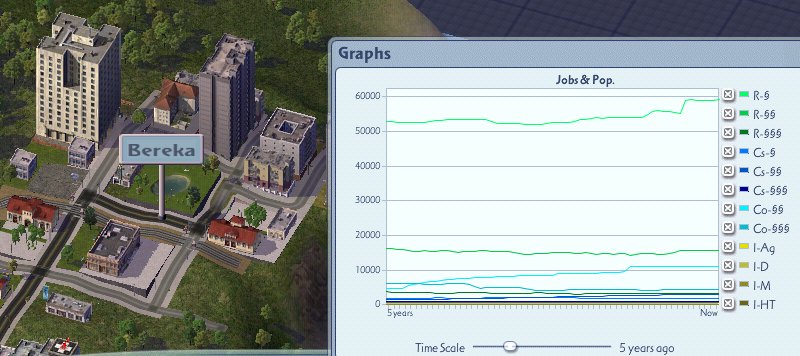
Like other cities commercial office demand fell through the floor on Fray Bentos, some offices even had to be torn down for medium density services in their place. The citys high-tech industry did continue to grow though, almost all dirty and manufacturing industry has been replaced and Fray Bentos has become the center of the region for high-tech jobs. Growth stopped in the last year when more power was required.
http://apolyton.net/upload/view.php...rayBentos35.rar
 Attachment: fraybentos35stats.jpg Attachment: fraybentos35stats.jpg
This has been downloaded 91 time(s).
|
|
| |
|
|
|
vovan
|
|
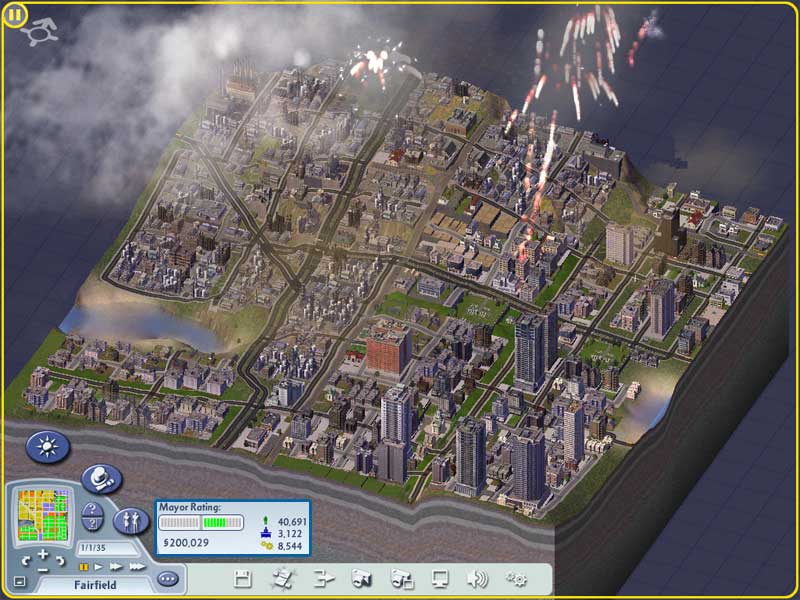
2035 was denoted by me reconciling the borders in order for the rail connections from the East to appear. Well, it pretty much destroyed half of my city, but given my substantial capital, that was not much of a problem. I took the opportunity to rethink the layout a little bit, and add better transportation. As a result, the population of the city has skyrocketed, which clogged up the rail system (one of the stations is being used by 9000 passengers a day).
Fairfield
Year 2035
Population: 40 691 (+90%)
Commercial Jobs: 3 122 (+33%)
Industrial Jobs: 8 544 (+10%)
Money: 200 029 (-63%)
http://www.vovan.net/sc4_game3/Vovan_Fairfield_2035.rar
EDIT: Also, just remembered, to get back in black for the budget, I had to establish some garbage importing deals with two of the neighbors - Bubble Junction, and Blountberg, I think. Please check your deals for unwanted garbage exports.
Attachment: 01-city.jpg
This has been downloaded 89 time(s).
|
|
| |
|
|
|
Atragon
|
|
My RCI demand got somewhat wonky, R$ and R$$ were spiked, R$$$ tanked (though not enough for existing R$$$ to move out, thank you well thought out planning in desireability), CS$ spiked while CS$$ tanked, CS$$$ was moderate. Now here is the strange part... CO$$ and CO$$$ were bouncing up and down seemingly randomly. (No abandonment thanks to taking out a $200,000 loan and building a landmark that resulted in a massive CO demand boost, and later a stock exchange).
I-A has had no demand at all, I-D is tanked completely (massive taxes, I do NOT want dirty industries), I-M and I-HT are high, I-HT is almost spiked, but I do not have anywhere to zone for I 

(Note, image is from 2030, not 2035)
Last edited by Atragon on 22-06-2005 at 19:54
|
|
| |
|
|
|
Lemmy
|
 |
Bubblewrap
Dec 2000
time: 06:21
|
|
Bubble Junction '35
Hot summer temperatures is causing me some overheating problems, i can't play for more than a few minutes at a time :/
edit:
R: 55469
C: 58518
I: 2628
Last edited by Lemmy on 23-06-2005 at 17:36
|
|
| |
|
|
|
Maquiladora
|
|
Just waiting on Y City.
|
|
| |
|
|
|
Atragon
|
|
Sorry about the delay, running it now.
|
|
| |
|
|
|
Atragon
|
|
Damn, I thought CO demand was just leveling off, it tanked despite all I could do (convention center, international airport, 5.5% taxes) and I have 3 empty high-rises.
Oddly enough, while I was bleeding CO jobs, the average income of my sims hit almost 70K
Ending stats:
R:139,827
C:30,954
I:6,290
www.atragon.ca/simcity/y2035.rar
|
|
| |
|
|
|
EPW
|
 |
California, USA
Jan 2004
time: 21:21
|
|
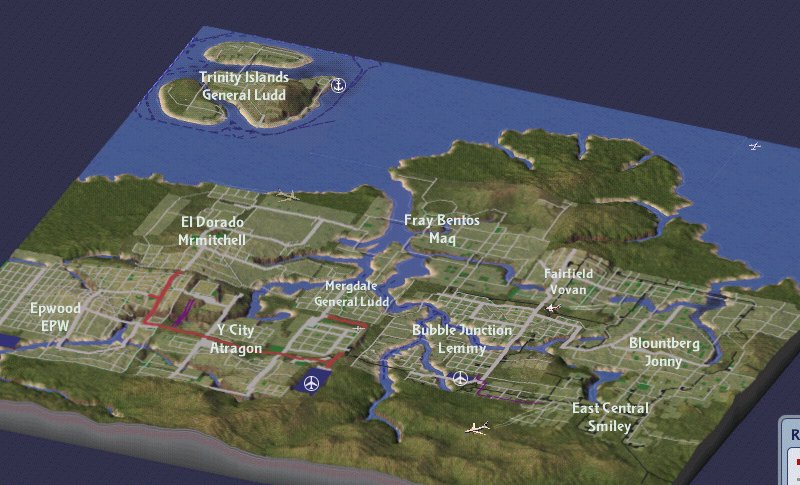
City Statistics 2035
Green=Highest in Region
Red=Lowest in Region
Epwood
EPW
Pop: 156,980(+23.6%)
Com. Jobs: 73,977(+.9%)
Ind. Jobs: 13,431(+6.67%)
El Dorado-2020
mrmitchell
Pop: 41,047
Com. Jobs: 12,426
Ind. Jobs: 8,522
Y City
Atragon
Pop: 139,827(+12.4%)
Com. Jobs: 30,954(-18.44%)
Ind. Jobs: 6,290(-8.8%)
Mergdale-2025
General Ludd
Pop: 42,440
Com. Jobs: 7,689
Ind. Jobs: 520
Blountburg
Jonny
Pop: 97,832(+41.77%)
Com. Jobs: 23,843(+8.87%)
Ind. Jobs: 18,864(+12.65%)
East Central
 Smiley Smiley
Pop: 73,122(+9.39%)
Com. Jobs: 15,381(+1.52%)
Ind. Jobs: 1,924(+7.96%)
Fray Bentos
Maquilidora
Pop: 4,277(-.41%)
Com. Jobs: 9,561(-11%)
Ind. Jobs: 10,187(+44.7%)
Bubble Junction
Lemmy
Pop: 55,469(+19%)
Com. Jobs: 58,518(-2%)
Ind. Jobs: 2,628((-23.4%)
Fairfield
Vovan
Pop: 40,691(+90.1%)
Com. Jobs: 3,122(+30%)
Ind. Jobs: 8,544(+9.9%)
Trinity Islands
General Ludd
Pop: 18,179(+71.8%)
Com. Jobs: 2,951(+80%)
Ind. Jobs: 5,842(+51.3%)
|
|
| |
|
| |
|
|
|
:) Smiley
|
 |
USCA, Berkeley
Feb 2001
time: 21:21
|
|
Buy Local - Building East Central's Downtown
East Central 2040
The boom-bust speculative cycle swung the other way this time, as a glut of high wealth residents caused a huge demand for office jobs.
Due to the city's low number of high wealth residents, the effect of the bust was minimal.
The office boom, on the other hand, needed to be kept in control to avoid a repeat of the Crash of 2035. Taxes were raised on Class A office space to over 10%, keeping existing businesses in town but stopping new ones from moving in.
Problem solved? Not entirely. While office demand instead went towards middle class offices, there still were lots of the rich who liked to patronize hipster clubs and art galleries in East Central. So, taxes were also hiked on high wealth commercial services to over 11% before demand subsided.
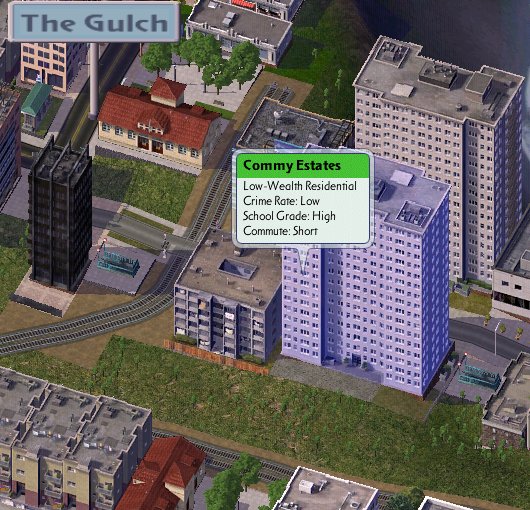
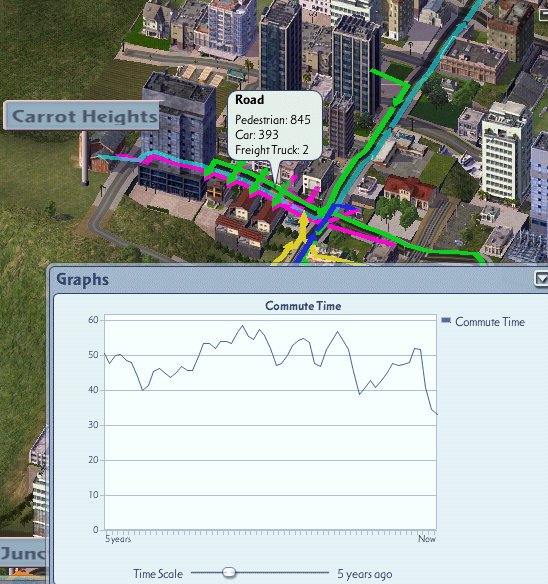
Now, land became available for offering the mostly lower and middle class residents jobs in town. New shops opened in many redeveloped lots across town, including formerly sleepy Carrot Heights.
Attachment: 29_carrot_heights.jpg
This has been downloaded 64 time(s).
|
|
| |
|
| |
|
|
|
:) Smiley
|
|
USCA, Berkeley
Feb 2001
time: 21:21
|
|
Regional Transportation Planning
quote:
Every morning, the city of East Central awakes with the sound of the 5 am whistle, heard throughout the city's 20-plus railroad stations as tens of thousands of janitors, hot dog vendors, assembly line workers and gofers board trains for jobs in shopping malls in Bubble Junction, chemical plants in Fairfield, and the famous Blount Works.
For others, the end of the line is only the start of journey, as they disembark at the Y Terminal. Jobs used to be plentiful in Y City, nowadays, however, it's another ride across the river to boomtown Epwood.
-East Central Daily News |
Looks like the east and west sides of town have taken different approaches to transportation planning.
On the east side, we have an extensive rail system, with subways, rails, and elevated lines.
On the west side, we've got highways and wide avenues. In between is a stretch of no-man's-land between Bubble Junction and Y City, plus one seriously clogged road through Mergdale.
How about a subway connection?
Attachment: 30_transit.jpg
This has been downloaded 63 time(s).
|
|
| |
|
|
|
:) Smiley
|
|
USCA, Berkeley
Feb 2001
time: 21:21
|
|
quote:
Originally posted by snoopy369
So, is it realistic, Smiley?  |
This newest version gets some things right with some glaring ommissions:
Good
(Reasonably accurate)
----------------------------
-Commericial development likes being located in areas with heavy traffic.
-Residents hate traffic noise.
-Trees clean the air.
-The area effects of the reward buildings are modelled nicely, for example, cheap housing gets built around universities.
Bad
(minor or correctable problem)
----------------------------
-No mixed use zoning, such as apartments over retail.
-Electricity and water are free services? I'd like to move there...
-Commercial density is low, this is linked with the lack of mixed use.
Ugly
(allows for unrealistic cities)
----------------------------
-Parking is not considered, buildings apparently have bottomless underground garages.
-All jobs / residents in a building are of same income level.
-Pollution doesn't cross borders, and hardly travels anywhere within city limits either.
Unknown
(Needs more data research)
----------------------------
-Health modelling - are sims that walk healthier?
-Conections between education and crime
next up, city evaluations.
|
|
| |
|
|
|
:) Smiley
|
|
USCA, Berkeley
Feb 2001
time: 21:21
|
|
City Evaluations of Realism in the SimCity 4 game model
Fray Bentos
I wouldn't call this good city planning but I've seen lots of cities like this in suburban America - a downtown along a main corridor, lots of houses, and in this case, literally islands of shopping centers and industrial parks accessible only by car. A real waste of waterfront if you ask me.
Fairfield
There's plenty of irony in the name - former factory sites aren't just any old piece of land, they are brownfields that need pollution cleanup. This type of environmental remediation is possible but the cost is not reflected in the game.
The city is as a whole realistic, it reminds me of Emeryville, a former industrial city across the bay from San Francisco, which has recently built lots of yuppie housing. Under the right wind conditions, factories near apartments is OK.
Epwood
It's unusual that highrise housing and shopping would be this seperated in a real city, where the main attraction of downtown living is proximity to restaurants and shopping. Presumably, such buildings would have a few businesses on lower floors.
The implementation of the subway system is very accurate, a large city with such a high degree of zone seperation could not function without extensive transit.
oh, and that airport runway facing the power plant stack-

more to come...
|
|
| |
|
| |
|
| |
|
|
|
:) Smiley
|
|
USCA, Berkeley
Feb 2001
time: 21:21
|
|
Trinity Islands
Generally, offshore islands linked only by boat are sparsely populated, cases in point Angel Island near San Francisco or the numerous islands in Hong Kong Harbor.
Industry would be very unlikely to move in, though farming is possible and tourism would be big. Also, bridges ought to be much more expensive to build.
Bubble Junction
The consolidation of office space in large office parks is quite common, in reality, however, you'd need lots and lots of parking space.
The different use, different cluster, model is often abused in city plans in China and other developing countries. Even in these cases it is rare to see such a high degree of zone seperation between residential and commercial.
Finally, intensive commercial development generally lines major roads, instead of spreading out into districts. In reality, there'd be a skyscraper-lined road with huge amounts of parking behind, much like Shiekh Zayed Road in Dubai.
Blountberg
The commercial corridors radiating from a mixed downtown is quite accurate, right down to the housing projects. Here's one point of objection- housing projects are built by cities, not private developers, and private low income housing is generally old middle income or high income housing.
The city's "concentric ring" layout is quite common, but there's a major difference: scale. At least in American cities, the mid-density and low-density residential rings would be far larger.
East Central
East Central was planned using a mix of no-use-zoning Taiwanese development and "Transit Village" planning.
The downtown is built Taiwanese style as a mishmash of uses, with adjustments made over time to fit demand. Here the game is inaccurate in making rezoning cost money - initial costs reflect the cost of hooking up utilities, street improvements, etc., changing from residential to commercial use should not require demolition or any high costs.
The satellite cities are built with the Transit Village plan, where housing surrounds a station and neighborhood retail. City services are also neighborhood based. This does work as intended, though in reality such a setup would require very good transit at the other end of the line as well.
|
|
| |
|
| |
All times are GMT. The time now is 05:21.
Apolyton Time is 00:21. |
top of page
|
|
|
Forum Rules:
You may not post new threads
You may not post replies
You may not post attachments
You may not edit your posts
|
HTML code is ON
vB code is ON
Smilies are ON
[IMG] code is ON
|
|
|
|
|
|





 22-06-2005 11:30







 I have unleashed a beast ...
  Good to hear it's at least moderately realistic.
 |
|