|
| |
|

|
Dr Strangelove
|
|
quote:
Originally posted by techumseh
York was more than a frontier outpost, it was a reasonable sized town and the capital of Upper Canada (Ontario). The Americans burned the government buildings, including the Legislature, which is why the British returned the favour and burned Washington the next year. This is an event in American history which is little taught in schools and almost never mentioned in polite society. It is particularly overlooked by American media for some reason. Conversely, it is well known in Canada. |
Actually at that point in history Washington was little more that a few unfinished buildings, probably smaller than York. What the British really wanted were the shipping yards building the American super-frigates, but they were turned back at Baltimore. Oh say can you see?
|
|
| |
|
|
|
Ted Striker
|
 |
United States of America
Jan 1970
time: 21:36
|
|
quote:
Originally posted by Oerdin
quote:
Iraq creating new breed of jihadists, says CIA
Ewen MacAskill, Duncan Campbell and Richard Norton-Taylor
Thursday June 23, 2005
The Guardian
The war in Iraq is creating a new breed of Islamic jihadists who could go on to destabilise other countries, according to a CIA report.
The CIA believes Iraq to be potentially worse than Afghanistan, which produced thousands of jihadists in the 1980s and 1990s. Many of the recruits to Osama bin Laden's al-Qaida had fought in Afghanistan.
The sobering caution came as a senior British anti-terrorism source warned that those trained in terror techniques in Iraq could use their newly-acquired skills in Britain at the end of the war.
The CIA report, completed last month, remains classified. But a CIA source yesterday confirmed that its broad conclusions, disclosed by the New York Times yesterday, were accurate.
The concern expressed in the CIA report contrasts with the optimism of US defence secretary Donald Rumsfeld two years ago when he welcomed the prospect of Iraq as a magnet for jihadists.
The Foreign Office and British security services are sceptical about the CIA assessment that the insurgency could spill into other countries. Security sources said that there was only a "trickle" of recruits from Britain joining the insurgency in Iraq.
If there was to be a spill-over, Saudi Arabia is potentially vulnerable because many of the Arab fighters in Iraq originate from there. Jamal Khashoggi, media adviser to the Saudi ambassador in London, said yesterday he agreed in part with the US assessment.
"It will be worse than Afghanistan," he said. "We are talking about a very brutal type, a very weird version of Islam in Iraq. It is very scary."
Mr Khashoggi predicted the approach of the Saudi government towards jihadists returning from Iraq will be very different from those returning from Afghanistan and Chechnya. "Any al-Qaida coming back from Iraq will be hunted. It is not like they have gone to Chechnya and will be coming back as heroes. If they come back from Iraq and brag about it, they will be snatched by security in a day or two."
The CIA report suggests the new breed of jihadists will be more deadly than those who fought in Afghanistan. It said that they have learned skills in urban warfare in Iraq.
While the number of Iraq attacks have diminished, they have become more deadly. More than 1,000 Iraqis and 120 US soldiers have been killed since the new Iraqi cabinet was formed in April.
Insurgents once again demonstrated their capacity for inflicting carnage on civilians when they detonated four cars bombs in western Baghdad last night, killing at least 23 people and injuring around 50. At least one was driven by a suicide bomber.
Earlier a bomb attack on a US military patrol killed three civilians. It was claimed by the al-Qaida group led by Abu Musab al Zarqawi.
There are about 200 individuals in Britain who are suspected of having received training in camps in Afghanistan and Chechnya. Senior anti-terrorist officials suggest many fewer have gone to Iraq.
Ken Jones, the chairman of the Association of Chief Police Officers' terrorism committee and chief constable of Sussex, said yesterday Britain would remain a prime target.
"There is an inevitable targeting of the United Kingdom and UK interests abroad," Mr Jones told a conference on terrorism organised by the Royal United Services Institute in London. "The threat will endure for the foreseeable future." But he added: "it is not inevitable that they will succeed."
Mr Jones noted that those involved in terrorism no longer necessarily came from the "excluded and marginalised" but were increasingly "highly intelligent, educated young people". In past terrorist campaigns, he said, there had been a clear goal or aim. The new form of attacks required a different response.
One of the most important ways to combat the growth of terrorism, he suggested, was by encouraging "confident communities" - a clear reference to Britain's Muslims -that would be aware of suspicious activities and would feel confident in reporting them.
Police in Manchester were last night given another 48 hours to question a 40-year-old man of north African origin, who was arrested under the Terrorism Act on Tuesday. It is believed that the man had shared a house in Moss Side with Idris Bazis, 41, a French-Algerian with a French passport, who blew himself up in a suicide attack in Iraq in February. Anti-terrorist sources say there is no link between the Manchester arrest and recent arrests of 11 men in Spain suspected of being connected with the Iraq insurgency.
Parents of 17 British soldiers killed in Iraq called today in a letter to The Guardian for an independent inquiry into the decision to go to war in Iraq. |
http://www.guardian.co.uk/Iraq/Stor...1512597,00.html |
This the danger. 
If we thought Al Queda was a threat, the next generation is going to make them look like schoolyard amatuers. I am very afraid of what the next 20 years is going to look like. The next generation is also going to bring the battle back to American soil.
They will strike when everything appears quiet, just as they did last time.
|
|
| |
|
|
|
Oerdin
|
 |
of Internet Music.
Sep 2001
time: 21:36
|
|
quote:
Originally posted by Lonestar
I think you may be mistaken with regards to the Indonesians. |
http://www.economist.com/World/na/d...tory_id=4105223
How others see Americans
Still not loved. Now not envied
Jun 23rd 2005 | WASHINGTON, DC
From The Economist print edition
Anti-Americanism is becoming entrenched, and getting more personal
IT IS two years since a surge of anti-American feeling greeted the start of the war in Iraq. In the past few months, the Iraqis have held their election; America has lifted objections to international war-crimes trials over Darfur; Israel's (American-supported) plan to pull out of Gaza has gathered speed; and Condoleezza Rice has been wooing Europeans diplomats with a kinder, gentler foreign policy. Surely, by now the spasm of hostility should be abating a bit.
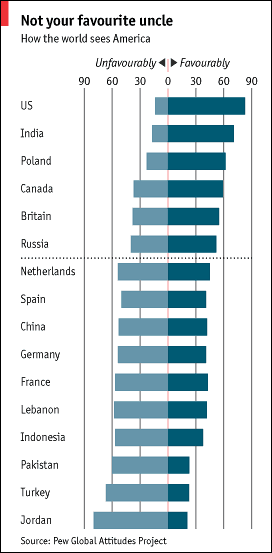
There are one or two signs of that in a new poll by the Pew Global Attitudes Project, the gold standard of international opinion surveys. Positive impressions of America have risen a few points in France, Germany and Russia since 2004, and have surged in India (since 2002) and Indonesia (2003). Against that, opinions of America are still well below their levels in 2000—and in most places they are still basically negative (see chart).
American officials usually downplay negative opinions as products of policy disputes or personal animosity, not hostility to the country itself. George Bush remains about as popular as a germ at a medical conference, and public support for the war on terror has slipped markedly in many European countries. This time, though, some American policies are actually popular. People in all 16 countries surveyed said America's relief effort after the Asian tsunami inclined them more favourably towards it (this may explain the sharp improvement in Indonesian opinion). Most countries responded well to President Bush's calls for democracy in the Middle East—though more so in Europe than in the region itself.
So it is all the more sobering to find considerable levels of hostility when people compare America with other countries, or express their views about Americans in general, not Mr Bush in particular. Pew asked its respondents to give favourability ratings to five nations: America, France, Germany, Japan and China. America came bottom of everyone's list everywhere except in India, where it was top, Poland, where it was in the middle and China, where it came above Japan. The British view France and Germany more favourably than they do America. China is more popular than the United States throughout Europe. (Germany won this particular beauty contest, by the way, scoring highly almost everywhere except Germany itself.)
The survey was conducted during the referendum campaigns in France and the Netherlands over the EU constitution. But scepticism about the future of their union does not imply that Europeans want closer transatlantic ties. Half or more in every non-American country surveyed said they wanted Europe to be more independent of the United States, and huge majorities—between 70% and 80%—said they thought the world would be better off if America faced a rival military power.
Americans themselves are still more popular abroad than their country or their president. But the gap has narrowed, partly because the positive image of Americans has declined considerably since 2002. Other people think Americans are hard-working and inventive, yes. But in most countries, more than half think of them as greedy and violent and, in the Middle East, as immoral.
The Pew poll even raises questions about how far others still see America as the land of opportunity, as Americans do. One question asked: “Suppose a young person who wanted to leave asked you to recommend where to go to lead a good life—what country would you recommend?” Nobody except the Indians picked the United States first (see table).
Given the lack of consistent long-term data, it is hard to know how these attitudes compare with, say, the 1960s. But this is the fifth survey of its kind since 2000. For that period, the Pew polls provide strong evidence that anti-Americanism is more than a blip associated with Mr Bush or Iraq.
 Attachment: cus159.gif Attachment: cus159.gif
This has been downloaded 67 time(s).
|
|
| |
|
|
|
Jon Miller
|
|
quote:
Originally posted by techumseh
York was more than a frontier outpost, it was a reasonable sized town and the capital of Upper Canada (Ontario). The Americans burned the government buildings, including the Legislature, which is why the British returned the favour and burned Washington the next year. This is an event in American history which is little taught in schools and almost never mentioned in polite society. It is particularly overlooked by American media for some reason. Conversely, it is well known in Canada. |
the burning of the canadian buildings is little talked about
the burning of the white house is one of the more talked about bits of that war
(that and Andrew Jackson)
JM
|
|
| |
|
| |
|
|
|
techumseh
|
 |
of the frozen North.
Apr 1999
time: 22:36
|
|
quote:
Originally posted by Oerdin
I love it! China continues commiting cultural genocide against Tibetians and has millions of jailed political prisoners but you folks think the US is worse because it has 200-500 jihadis who were caught red handed and were chucked in Gitmo. |
Here's more bad news for you:
quote:
Canadian opinion of U.S. dropping, poll suggests
Last Updated Thu, 23 Jun 2005 18:41:22 EDT
CBC News
An increasing number of Canadians have a negative opinion about their southern neighbours, calling them "greedy, violent and rude," suggests a new survey.
About 66 per cent of Canadians have a favourable opinion of Americans, down from 78 per cent in 2002, according to a Pew Research Center poll released on Thursday.
The Washington-based research company surveyed roughly 17,000 people in 16 countries, including Canada and the United States.
A majority of Canadians (more than 60 per cent) feel Americans are "greedy, violent and rude" and a minority said Americans are "immoral."
On the positive side, more than 76 per cent of Canadians feel Americans are "hardworking and inventive," but less than half feel they are "honest."
About 59 per cent of Canadians reported a positive opinion of the United States as a country, down from 72 per cent three years ago. Canadians rated countries like France, Germany and Japan higher than the U.S.
Of the 16 countries polled in the survey, six said a majority of their people had a positive opinion of the U.S. They were the U.S., Canada, Great Britain, Russia, Poland and India.
Of the 500 Canadians surveyed, 75 per cent said the re-election of U.S. President George W. Bush made them feel more negative toward their southern neighbour.
"The magnitude of America's image problem is such that even popular U.S. policies have done little to repair it," said the report.
Americans believe U.S. disliked
The survey results suggest Americans are aware of how their country is perceived, with 69 per cent of Americans polled saying their country is "generally disliked" by other countries.
By contrast, 94 per cent of Canadians polled believe their country is well-liked.
The survey, which was co-chaired by former U.S. secretary of state Madeleine Albright, took place from May 6-11, 2005. The margin of error is plus or minus four percentage points, 95 per cent of the time.
|
|
|
| |
|
|
|
Gatekeeper
|
 |
United States of America
Feb 2000
time: 23:36
|
|
quote:
Originally posted by Oerdin
I love it! China continues commiting cultural genocide against Tibetians and has millions of jailed political prisoners but you folks think the US is worse because it has 200-500 jihadis who were caught red handed and were chucked in Gitmo. |
The reason for this, I've been told, is because the rest of the planet knows it can't do jack when it comes to changing internal Chinese policies — they can complain all they want, but it won't matter much because China isn't exactly a representative democracy nor transparent.
However, with the United States — which is a representative democracy and more transparent — it's felt that when we're the subject of vitriol, scorn and legitimate criticism, it'll have an effect and, perhaps, change our policies, internal and external.
So, with that in mind, I try to just put up with a lot that's said of America. One might even say it's a good thing (the idea being that if people are communicating with each other, even in the form of seven insults for every three compliments, it's better than utter silence), unless of course it's some broad generalization and/or stereotype, at which point the gloves sometimes come off.
Gatekeeper
|
|
| |
|
| |
All times are GMT. The time now is 05:36.
Apolyton Time is 00:36. |
top of page
|
|
|
Forum Rules:
You may not post new threads
You may not post replies
You may not post attachments
You may not edit your posts
|
HTML code is ON
vB code is ON
Smilies are ON
[IMG] code is ON
|
|
|
|
|
|






 25-06-2005 18:26





 |
|