|
| |
|

|
Willem
|
 |
Canada
Dec 2001
time: 00:17
|
|
quote:
Originally posted by solo
One question for Willem and Zachriel:
Did the AI have the technology yet for those resources it did not go for? In my experience so far, they have zeroed in on resources, but now that I think about it, they might have had the technology to "see" them at the time of zeroing activity.
Aeson's experience suggests they know where unseen resources are, too, but it may just be a coincidence due to the fact that smaller CivIII maps result in all areas being setlled fairly quickly into the game. However Aeson IS having a lot of success by using the theory that the AI do know in advance where resources are.
Another factor to consider is the scarcity of a resource. The AI may not bother about an unseen one or bunch, if they already have their own copy from another tile in their possession.
One thing for sure, is that more evidence needs to be collected while playing games, before forming any conclusions. |
Well that's a good point, and I'm not really sure. I know in one case, the 3 resources in one area, there was a resource that he did have the technology for, Iron, but one of the others, Saltpeter, I'm not entirely positive about. At least he didn't have any musketmen on his front line at the time.
Now the land in question wasn't the greatest, so maybe there's some calculation that goes on in order for the AI to place some priorities on city placement, with the resources just being one of the factors, seen or unseen. It does seem a little too coincidental when I hear stories of people's experiences with a persisant settler, but when I come across something like that (how often does 3 resources occur in the same area), I have to wonder.
Another possibility I just considered, the area with the 3 resources was on the far end of his empire away from me and from anyone else for that matter. I was thinking of sending a Settler in, but it didn't seem practical since there would be a real risk of assimilation. So maybe the location wasn't a priority at the time since the AI would consider that area secure for future use. Possibly these instances of the AI showing this uncanny ability of detecting resources involved some sort of risk analysis, with the AI deciding that it would be best to grab the spot before anyone else did.
|
|
| |
|
|
|
macaskil
|
|
AI cheats
1. I've never seen the "Tech Trade" cheat. Last night I managed to sell the same tech to 12 different civs in the same turn for about 500 gold per turn.
2. I've never seen the "AI miraculously finds resource" either. Again, last night the AI founded a city in a jungle 3 squares away from coal and I had time to send my settler there and grab the resource. What the AI DOES do is found cities EVERYWHERE - deserts, jungles and mountains. Human players don't. Hence, the AI is more likely to find a resource by accident. If in 100 games I NEVER found a city in a desert and the AI ALWAYS does, who's going to find the saltpeter? This is annoying but if I don't like it I should cover the deserts with cities like the AI does.
I'd prefer Dan and his clan to fix the REALLY annoying bugs eg crashes, lack of customisability, no useful scenarios, planes can't sink ships etc.
EXPERIMENT
Build a huge Pangaea world, all desert. Place a few saltpeter deposits on it. Then see if the AI civ manages to find them before you do (you know where they are!).
|
|
| |
|
|
|
barefootbadass
|
|
quote:
Originally posted by Hermann the Lombard
(and especially without having to trip the "offer" button |
I don't think the offer button does anything but take a little of your time to go see what trades you have. No effect on their relationship with you, whatever it says to you when you finish negotiating I think just reflects their current attitude towards you.
Also, you can hit escape and go straight back to the initial diplomatic screen without having to see the 'I don't have time for this.' message or whatever.
|
|
| |
|
|
|
solo
|
|
Lowell, MA USA
Jan 2001
time: 05:17
|
|
One consistent theme in CivIII is that the AI like to crowd the human player with new cities as quickly as possible. We are more apt to notice resources being claimed from right under are own noses, while paying less attention to other parts of the map. It could be just a coincidence and consequence of the programmed AI "settler rush strategy", that deprives the human of terrain and any resources that go with it.
|
|
| |
|
| |
|
|
|
Analyst Redux
|
|
I'm a bit surprised that there is such resistence to accepting the idea that the AI gets map cheats. That the AI got map cheats was admitted to more or less as a matter of course by the designers with respect to Civ and Civ II. When they produced SMAC, the Firaxis programmers boasted of the improved pathfinding abilities of the AI and stated that this had allowed them to reduce the AI's use of/dependence on map cheats. Both of these claims turned out to be exaggerated. Anyone who spent any amount of energy breaking down the AI behavior (especially by designing scenarios) could see that many of the old map cheats were still in effect.
No one here has noted yet that one of the things the patch fixes is the AI's ability to "see"--for combat purposes--enemy ships that should be invisible to it. Stop and think for a moment: if the AI doesn't get map cheats in the first instance, how could this bug possibly have arisen?
The fact is that the designers have admitted (as others have already pointed out) that they haven't figured out a way to get the AI to do anything useful without giving the AI access to the map dataset in order to do calculations about where it wants to move its units, whether it should try to kill you with them, and how it should try to accomplish that. I suppose you can call it a "cheat", but the real point is that the game simply wouldn't work (or, more precisely, the games designers are at a loss as to how to make it work) without giving the AI this access.
Anybody who's played these titles for any amount of time can see that Civ III's AI, just as its predecessors' has an uncanny ability to seek out weakly defended cities, units in the open it shouldn't be able to see, etc. The explanation that the AI has the same tools to investigate cities as human players doesn't even come close to explaining all of the AI's uncanny choices.
And I've noted the AI's advance knowledge of hidden resources. I'm amazed that it can even be considered a controversial declaration that the AI sees those resources. Of course, making the case against the stubborn apologist is handicapped by the lack of precision scenario creation tools. Ironically, shortcomings in this area prevent conclusive investigations into shortcomings in other areas.
FWIW, I'll relate an anecdote from my current game. Those who are already convinced will be amused. Those who aren't will rationalize it away.
I elected to play the Iriquois and, despite selecting the default map settings, wound up on a pangaic continent shared by 6 other civs--the poor Zulu were stuck on a pathetic sub-arctic island. [Side note: the daunting presence of miles and miles of deep ocean tiles did not stay the Zulu galleys from their appointed rounds. Yes, Virginia, the AI triremes are still unsikable, just as they have always been.] My most immediate neighbors, and fiercest competitors for land, were the Aztecs, who began to my East. To my West were the French. The Greeks were to my immediate North, while the English were north of the Aztecs. There was a great desert separating the Iriquois and Aztecs from the Greeks and English.
Because I was not very nice to them--hemming in their cities, aggressively culture-rushing at their borders, etc., the Aztecs declared war on me. My mounted warriors prevailed, but because the Aztecs were large, and I was pacifying their cities rather than razing them, it took some time. Eventually, I destroyed them, my last two prizes being their northernmost cities built in the desert.
The moment I took that last Aztec desert city, the English, without calling for any negotiations, declared war on me. I'll make a long story short. That last desert city contained the only Saltpeter tile within the borders of my current (which included the former Aztec) and present English empires. Not that the English should have known that, since they--like all other civs in the game--were still several techs away from Gunpowder. The only city that England ever attacked during that war was that crappy little desert city. They continued to attack it, even while I took other cities of theirs. They refused all envoys, never even deigning to talk peace. This kept up until someone (the French, I think) traded them the Gunpowder tech. The English then traded for French saltpeter (the french had two extras) and immediately asked me for peace, agreeing to give up two more cities to me to get it. Mind you, until that very turn, they would not receive my envoys, but after that, they were thrilled to give up two cities to get peace.
This game has also been kind of amusing in the area of the AI trade-behind-your-back ploy. I got into a warfare rut this game. Everyone is furious with me--er, those left alive anyway. The Greeks have had some "fine incense" to trade for, oh, about the last 40 turns. I tried trading for that incense after booting up from a save. The Greeks had 0 incense to trade. Return to the trade advisor and the incense is gone--traded to the Zulu. So I exited without saving and restarted. Played about 5 turns and the incense is still there. Saved. Contacted the Greeks again. Bam! Incense vanishes. Rebooted from save. Lather, rinse, repeat. It was some 40 turns or so before the Greeks actually traded the incense to the Zulu on their own. But any time that I talked to the Greeks in between. Bam! It was gone. 
I understand why the designers did it, but the execution strikes me as silly. Why not just have the AI, when furious, refuse to trade you the resource item at any price? I can even see a minor exploit springing from this. The reason the Greeks never traded the Zulu any incense is that the Zulu had no good value to give. But any time I liked, I could force the powerful nation (the Greeks) to give away something to a pathetic weakling who would not be helped by it, get nothing in return, and be bound to that crappy deal for 20 turns. I'd say that logic pretty much always applies to backdoor resource deals. If the powerful AI civs trade something out from under you, at least you forced them to give a resource away for nothing, which doesn't exactly help them against you, now does it?
Aeon has also pointed out how one can force the AIs, by use of the negotiating tool, to reveal what they know of hidden resources. Always take the logic the next step. Once you figure out what the AI is doing, you can figure out how to exploit it. Dont' get mad--get even.
|
|
| |
|
|
|
solo
|
|
Lowell, MA USA
Jan 2001
time: 05:17
|
|
I downloaded Aeson's file, attempting the trades as suggested. The AI would not budge on the "hidden" aluminum or saltpeter, in spite of plenty of trading leverage. On the other hand, Nothing and other resourceless city could be had for accepting peace. I urge the doubters to download this save and see for yourselves, as the evidence it provides for AI pre-knowledge of resource locations is quite convincing.
|
|
| |
|
|
|
Sir Ralph
|
 |
Long live teh Schwampel!
Dec 2001
time: 06:17
|
|
quote:
Originally posted by solo
I downloaded Aeson's file, attempting the trades as suggested. The AI would not budge on the "hidden" aluminum or saltpeter, in spite of plenty of trading leverage. On the other hand, Nothing and other resourceless city could be had for accepting peace. I urge the doubters to download this save and see for yourselves, as the evidence it provides for AI pre-knowledge of resource locations is quite convincing. |
I checked it and it worked like it was described. Btw, still playing the Zulus Aeson? 
But I think it doesn't prove that the AI knows, that there are resources, but only, that there must be something valuable. Probably, the AI has a function "EvaluateCitySite()" or so, and this function (not the AI itself) has the ability of seeing the resources and giving higher results with resources than without. But the AI actually doesn't know, what it is exactly.
|
|
| |
|
|
|
bsklepzig
|
 |
Wisconsin, USA
Jan 2002
time: 23:17
|
|
quote:
Originally posted by Sir Ralph
But I think it doesn't prove that the AI knows, that there are resources, but only, that there must be something valuable. Probably, the AI has a function "EvaluateCitySite()" or so, and this function (not the AI itself) has the ability of seeing the resources and giving higher results with resources than without. But the AI actually doesn't know, what it is exactly. |
I don't want to seem flip, but it feels like there is this impression that the Firaxis team has somehow managed to create true Artificial Intelligence. The "AI" for Rome or the Aztecs or anyone else isn't the HAL 9000 or Data from Trek. It isn't a discreet entity, where one part of it's computer brain knows something and the other doesn't. I doubt that even Deep Blue (the IBM hardware/software combo that beat a human Grand Master at chess (Kasparov?)) had discreet subroutines that shielded it's knowledge from the knowledge of the programmers. (And that effort (I'd wager) had significantly greater resources dedicated to perfecting the AI. For starters, it ran on a Super Computer or Mainframe, I think.)
The AI IS the collection of functions programmed by Firaxis. It doesn't even make sense to speak in terms of what the AI "knows." That's a very human perspective. The series of calculations that include calculating the value of a tile based on the presence of aluminum (for example) IS the AI. Nothing more.
I REALLY doubt there is a discreet AI personality for the Zulus. I'd bet the farm it's a series of IF ... THEN ... statements (or some equivalent, depending on the native code environment).
IF ZULU
THEN ... (a bunch of variables change)
When the program evaluates land for settlement on "Zulu's" turn, a calculation happens.
IF TILE ... (has aluminum)
THEN ... (a variable changes to indicate the tile has good resources)
Other variables considered probably include proximity to water, food resources, terrain, etc. All things a human would consider. The difference is the program knows all resources from the first turn. Not really a huge problem for the human, since we have so many adaptive advantages over the program. We settle where resources will LIKELY appear (desert for aluminum and mountains for uranium), then go to war or culture bomb if our guesses were wrong.
Just don't give too much credit to the "thought process" or "decision-making" or personality of the AI. It's just a bunch of variables in a series of calculations.
(And before anyone chimes in with "that's all a human brain is," humans are exponentially, infinitely more complex, with tangential, inductive and deductive reasoning that still baffles biologists and philosophers. The best AI can't begin to touch what a human's thought process is, and -- with all due deference to a fine team of programmers that developed a terrific game -- Firaxis is not on the cutting edge of AI research.)
|
|
| |
|
|
|
Aeson
|
 |
orangesoda
Nov 2001
time: 22:17
|
|
It's possible that the AI calculates the value of unseen resources when determining the worth of an already founded city, but not in founding the city, or making terrain improvements. What the AI "knows" is defined by the programmer in any given function. If the EvaluateCity function adjusts for unseen resources, then the AI knows that they are there at that point in the program. If the EvaluateCitySite function doesn't use the value of unseen resources, then the AI doesn't know they are there when finding a city site. It really doesn't add much complexity to the program to make a tech level inquiry when determining the value of any given tile.
if(Tile->Iron)
{
if(Civ->Ironworking)
{
TileValue += IronValue;
}
}
I'm not very experienced at programming, but even I could figure out how to include this in one area of the program, but not another. Not to say this is how they did it, just that it could be done.
quote:
humans are exponentially, infinitely more complex, with tangential, inductive and deductive reasoning that still baffles biologists and philosophers. The best AI can't begin to touch what a human's thought process is |
Can't help but 'chime in' here:
It is just impossible for any "program" to understand itself completely, humans included. To achieve understanding, there is required change in the data or fuction of a program. What you get is a program that may understand what it was, but not what it has become in that process. We are the best AI that we know of, even if(SelfImage > Reality){makes that hard to accept}.
|
|
| |
|
|
|
solo
|
|
Lowell, MA USA
Jan 2001
time: 05:17
|
|
Looks to me that barbarians give equal attention to the AI, but I have yet to see them defeat the AI in battles witnessed, including one where one of those stacks of 20+ horsemen went up against one Zulu spearman and lost! However, after taking into consideration the fact that the spearman was fortified and was located on a mountain, I concluded, "Of course! It always happens like this with such a good defensive position!"
|
|
| |
|
|
|
WFHermans
|
|
Another fun thing is when the 20+ stack of Barbarians appears next to your just built 1 small town....and after they cleansed it out almost ALL your money is gone...mmm I must have had the Royal Treasure in that little village.
Again not that I mind.
I never saw the Barbarians take an AI city but I suppose that is coincidence.
Oh and I just thought of another way humans cheat: they don't take their alliances as seriously as the AI.
|
|
| |
|
|
|
Aeson
|
|
orangesoda
Nov 2001
time: 22:17
|
|
AI Cheat:
Can "see" weakly defended cities anywhere on the map.
Player Counter:
Use purposely weak city garrisons to draw AI offensives away from strategically important areas. In some cases start a game of AI "ping pong".
AI Cheat:
Can "see" undefended bombardment units, workers, settlers.
Player Counter:
Leave these units (preferably bombardment units) out in the open, on high movement terrain. AI offensive units will be left out in the open for counter attack, and usually the captured unit will be reclaimed the next turn.
AI Cheat:
Can "see" resources that aren't visible for their tech level.
Player Counter:
Use the AI as your eyes, finding later resources by their willingness to part with cities.
AI Cheat:
Trading during the Humans turn.
Player Counter:
Not really anything you can do. The AI will give away techs for free rather than let the player make more trades. A very good reason for bloodthirsty tactics to begin/resume. Sadly the AI will never learn from it's mistakes, even when they know that my 100 Horsemen/Knights/Calvary/Tanks/Modern Armor are going to demand satisfaction for the AI's underhanded ways.
AI Cheat:
Free Starting units depending on difficulty level.
Player Counter:
Use the fact that the AI has 5-10 extra warriors/spearmen to support early on to your advantage. Wait a bit, and then hit them with Horsemen or Swordsmen. They won't have as many of these up to date units because their army is still comprised of many of their obsolete starting units. If this doesn't help, try a lower difficulty level.
AI Cheat:
Production bonus depending on difficulty level.
Player Counter:
Let the AI build cities and wonders for you. They will build them more efficiently than you could. Put the saved production into military that will be used for wonder aquisition. After the wonder is in hand, just keep on rolling with your military advantage over the AI. A nice side benefit is that a leader (free wonder) could be generated in the process. If this doesn't help, try a lower difficulty level.
AI "Cheat": (pre-patch)
Moving across ocean with galleys (with the Lighthouse).
Player Counter:
Build the Lighthouse yourself, the AI will be stuck to ending it's turn on coastal tiles while you can go anywhere with your galleys. Also realize that once Astronomy is researched, the AI will be able to move onto sea tiles. With Magnetism, Galleys can go anywhere.
'Dirty' Lighthouse Use:
The AI will only cross sea tiles with galleys (pre-Astronomy) if they can end their turn on a coastal tile, making 2 sea tiles their max crossing. They also will not attack any ship in a sea tile. Use this to make invincible sea Galley blockades until Astronomy.
|
|
| |
|
|
|
Aeson
|
|
orangesoda
Nov 2001
time: 22:17
|
|
quote:
Originally posted by pchang
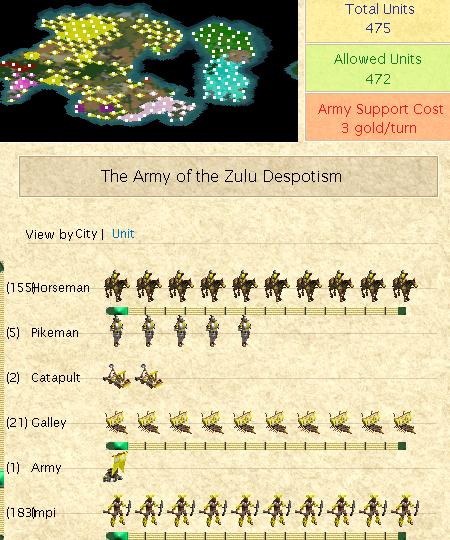
I bow to the incredible patience and fortitude that is Aeson. 475 units?!?!?!?! I would never have the patience to deal with moving that many units. How long does it take to make each turn? How long do you have to wait between turns? My god! the humanity! |
Haha, I usually play 1 or 2 turns and then switch to another game. It takes about 20 minutes to get through one of my turns, the sad thing is it is only going to get worse! I produce on average 20 units per turn, and don't lose half that many, even on the worst turns. Luckily half my army is fortified in the northwestern portion of the map. They are waiting for the Galley fleet to be of sufficient numbers for a crossing. Also waiting for the Knight upgrade. The worst part of it is the 100's of captured Workers I have running around that aren't shown on the screen there.
I have named all my pop rush cities (everything outside the main northern circle of cities) to 1nationality# for easy recognition in the domestic advisors city list. I just switch to listing by population, and pop rush any of the cities that have reached size 2. I'm up to 1french15, 1indian17, 1babylonian12, 1persian19, 1chinese2 (been razing most of their cities because of cultural concerns). Also I keep steady at about 3 cities being settler disbanded for relocation each turn. Gotta keep the city pattern right! At least my 1.33GHz/512MB machine processes the AI turns in about 20 seconds, but it's early.
|
|
| |
|
|
|
Aeson
|
|
orangesoda
Nov 2001
time: 22:17
|
|
I think it is quite fun. I look at is as playing several games at once, I have 2 "builder" games going (one around my palace, one just starting around the forbidden palace), and 2 military conquest games going all at once! I just take it slowly, as there is a lot of "fun" that could become tedious playing too many turns in a row It is nice that I can get a great leader just about any turn that I don't already have one. I just used one for Sistene's, and hopefully I can get one for Leo's. After that, none of the wonders should be in question.
I am dreading the period after the conquest is taken care of though, as I'll just have terrain improvements going on forever during the buildup.. not to mention figuring out how many tiles I can claim safely without triggering domination. That's part of why I'm sticking to a very strict spacing pattern, as I can more quickly count if each city claims a certain number of tiles. Eyeballing it, I would say that I can safely claim about 4/5ths of the main continent, with a couple colony type cities on the other for resource purposes.
The real power of pop rushing is that almost any corrupt city can still churn out 1 unit every 5 turns (with the pyramids) or faster. I was able to expand faster than 2 of the AI civs who started out near jungle areas, and so was able to demand cities from them very early on. This made me more powerful than a couple of the other civs, who I could then demand cities from. My first 10 or so "conquests" came this way, and most of my Impies were pop rushed from those cities, leaving my core to build peacefully. Coastal cities were able to rush Horsemen after a Harbor and Barracks. I also set up a few temp cities in really high food areas. 5 of these cities were producing a unit every other turn. Every 20 turns I was able to demand more cities, and captured others in the meantime. It just kind of snowballs out of control.
|
|
| |
|
|
|
WFHermans
|
|
I am certain it is a stupid question, but what is "pop rushing" units? And it is something the AI can't or doesn't use?
|
|
| |
All times are GMT. The time now is 05:17.
Apolyton Time is 00:17. |
top of page
|
| archivepost |
|
Forum Rules:
You may not post new threads
You may not post replies
You may not post attachments
You may not edit your posts
|
HTML code is ON
vB code is ON
Smilies are ON
[IMG] code is ON
|
|
|
|
|
|






 01-02-2002 22:41


 I will fire my current fact checker and get back to you on that subject.
 Attachment:
 Attachment:
 .......)

 |
|