|
| |
|

|
HershOstropoler
|
|
"I don't have a copy of the article (as I said before it was a journalistic piece), but I can send you a hard copy if you really want, though it just makes the points I made in the thread. My academic work is in econometric modelling of labour markets..."
We have a couple of journals at the library, so probably a reference will do.
"...believe me I am not being up my own ass when I say I will not discuss it with you."
Who knows ? Maybe I agree with you ?
"you have a surprising amount of knowledge of facts for a non-economist but no structure, which is why you have misconceptions."
Or maybe I have a different structure for those facts ?
"should we discuss a legal issue and you said to me "Sorry, you've misunderstood that, in fact it's like this _insert legal explanation_", I would accept you have more insight"
That is only reasonable if I provide more facts than you have available. If you lack a legal text or a key court case, yes. If it relates to the interpretation and understanding of those, it is in no way a foregone conclusion that my understanding is better.
"Your inability to admit my posts on deflation/monetary targeting/NAIRU/Solow model/various monetary policy issues all provided you any insight that you had previously not considered is, quite frankly, in my opinion unbelievable."
Well let's see if Saras finds your corrections to my misconceptions... 
"if you studied economics for as long as I have"
So you started before 1990 ?
|
|
| |
|
|
|
DanS
|
 |
Kickball Capital of the World
Jan 1970
time: 00:23
|
|
"Concern about deflation in Japan still sounds silly to a guy who grew up hearing how the Japanese economy was totally export driven and domestic consumer goods were all priced through the roof. "
This circumstance seems to no longer be the case, at least anecdotally in selected industries. In the last generation of products, domestic elecronics sold at 1/2 the price of the export product. There was a lot of opportunity to pay a purchaser 5% to buy domestically and then export the product to you.
In the latest generation, the difference is less. Maybe 2/3rd the price. Then figure future dollar depreciation and we're starting to see something loosely resembling rational pricing...
On another subject, here's a good article about American labor markets and immigration. Demographers have been going nuts with the cornucopia of Census 2000 for the last year or so, and we're likely to see more detailed studies of this type...
http://www.washingtonpost.com/wp-dy...6-2002Dec1.html
Also wrt demographics, here's a good article about the shortage of marriageable women in India due to sex selective abortions. India's future population pyramid looks excellent, but things like this could screw it all up easy...
http://www.washingtonpost.com/wp-dy...2-2002Dec1.html
Edit: Just as soon as I start talking about dollar depreciation against the Yen, I get contradicted by the Japanese finance minister who says 150Y/$. 
http://news.ft.com/servlet/ContentS...p=1012571727088
But this just doesn't make any sense to me. Hopefully, the dollar will have an orderly, modest depreciation.
Last edited by DanS on 02-12-2002 at 21:38
|
|
| |
|
|
|
DanS
|
|
Kickball Capital of the World
Jan 1970
time: 00:23
|
|
Sorry to bombard the thread with articles, but...
The following is a call by Japan to "reflate" the global economy.
http://news.ft.com/servlet/ContentS...p=1012571727092
I don't agree with it at all (except the Japan part), but don't really have an overriding, educated context.
The only point I would raise is that Japan can't rely on the US (buy more) or China (raise export prices) to pull its coals out of the fire. The US economy is enjoying cheap goods from China, thank you very much, and if Japan can't compete in their target markets, they need to find more profitable target markets.
I saw a GE DVD/VCR combo for $75 in the weekend circulars, for instance--I was floored. This combo probably contained no Japanese parts. Probably some American intellectual property for Malaysian or Taiwanese fabbed integrated circuits. Maybe a couple of South Korean parts, such as memory. Assembled in Chinese factories owned by Taiwanese businessmen. We couldn't beat Japan long ago and now China on some things, so we joined them...
I agree that Japan should peg a high inflation figure and do whatever it takes to hit it, but why the US and Europe?
Last edited by DanS on 02-12-2002 at 22:30
|
|
| |
|
|
|
DanS
|
|
Kickball Capital of the World
Jan 1970
time: 00:23
|
|
This article is a case-in-point of why I dislike the Economist. The article about what Sten/Colon are discussing wrt to two-tiered pricing is based in part on the ridiculous assertion that "[u]nder Bill Clinton and the younger George Bush, America has drifted further from its commitment to global free trade, and is thus less able to criticise others."
http://www.economist.com/world/asia...tory_id=1469455
What a load of crap. Why does the Economist sometimes spout stuff that obviously isn't so? Not a week ago, the US concluded a Free Trade Agreement with Singapore and advocated removal of all tarrifs on manufactured goods globally by 2015. Clinton put through NAFTA and also worked hard on free trade, even though he didn't have fast-track negotiating authority from the congress.
Last edited by DanS on 02-12-2002 at 23:37
|
|
| |
|
|
|
Colon
|
 |
Antwerp, Colon's Chocolate Canard Country
Jan 1970
time: 06:23
|
|
I don’t like the first FT comment at all, it has too many misconceptions and platitudes.
“The entry of emerging market economies - such as China and other east Asian nations - into the global trading system is a powerful additional deflationary force. Their combined supply capacity has been exerting downward pressure on the prices of goods in industrialised economies.”
This ignores that those countries demand is entering the global trading as well as their supply. China is a market as well as a competitor, as other Asian countries already have been discovering. The problem is not China’s supply capacity on itself but that they have an overcapacity relative to their domestic demand. I think this problem will diminish as China is restructuring it’s state industries.
“This is particularly true when the financial sector has been damaged, as in Japan. In order to cope with economic stagnation, there has been aggressive fiscal expansion since the early 1990s. Several years after the collapse of the bubble, the Bank of Japan belatedly shifted to easy monetary policy. Then it gradually guided the short-term money market rate below the discount rate, but without much success in stopping price deflation, let alone reviving economic activity.”
I’m really unconvinced that the BOJ is to blame, even if it did react to slowly you can only say that with benefit of hindsight. Japan’s economy was going down slower than US’ lately so it only seems logical they reacted more slowly.
The real blame IMHO lies at the intertwining of interests between the commercial banks, the LDP and industry. It’s remarkable how Japan’s most successful companies stand outside of this Gordian knot. (eg: Sony, Toyota)
“Actual inflation may be 1-2 percentage points below what the indices show. A central bank should maintain a buffer zone to reduce the risk of inflation entering negative territory. Inflation targets should therefore be set at a level that minimises the risk of deflation. For the European Central Bank the target could be 2-3 per cent a year. The BoJ's target should be higher.”
Firstly, actual inflation may also be 1-2% above what the indexes show, due liberal use of deflators (taking into account quality improvements) while not taking into account of quality diminishments (particularly an issue in the service sectors). Mrs Baum mentioned this in the commentary I posted about above.
Secondly, ECB’s inflation target in effect has been 2-3%. It hasn’t increased rates even though HICP has been above 2% for a very long time already. Core inflation has even been on a slightly more upward trend than a downward one.
As a reminder, wage growth is still very healthy in both the EU and the US, and where wages go service prices tend to follow. (that service inflation is strong in both economies indicates this)
In principle M3 growth target in the Eurozone is 4.5%, but the actual growth has always been higher than that and currently it’s even standing at 7%. On what the criticism of an overly tight ECB is based is a mystery to me.
“If Beijing considers the second option more costly than the first, it should join the advanced countries in their efforts towards reflation. It is China's responsibility, and its interest as the largest emerging market economy, to contribute to global stability jointly with the US, Europe and Japan.
The writers are vice-minister and deputy vice-minister for international affairs at the Japanese ministry of finance”
Yeah, if I were a Japanese politician I’d really love to see my regional rival cut in its production capacity as well. 
[edit] I'm talking about the second FT article Dan posted.
Last edited by Colon on 04-12-2002 at 17:56
|
|
| |
|
|
|
DanS
|
|
Kickball Capital of the World
Jan 1970
time: 00:23
|
|
"Well that depends on what you mean by recently - but in the last 10-15 years the number as quadrupled."
I would like to see the breakdown. Also consider the flip side of the coin--this might just be a reflection of the unfair trade tactics of others.
"Now that's just daft 'justification' - what you are saying is that the US is 'tactically' doing things that will reduce trade liberalization globally (trade diversion in bilateral deals) because it cannot make any progress in multilateral trade liberalization.
That's like deciding to add weight to a car because it's not going fast enough."
Your simile doesn't hold. It doesn't add "weight", but reduces it. By following your simile, even regional trade deals (NAFTA, AFTA) would add weight, because it's not global.
Whether or not it reduces weight sufficiently is a fair question, of course. And that's where it's value as a tactic comes to the fore. Else, why would we sign these deals, if it didn't benefit us one way or another?
Or am I missing something here?
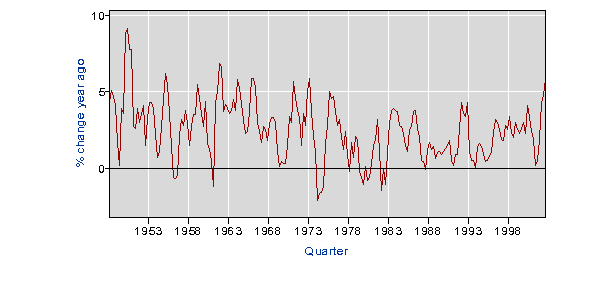
On another subject, how about those productivity numbers, eh? Highest rate since Q1 '73. It's tough to believe them.
 Attachment: prs84006091_89610_1039190195482.gif Attachment: prs84006091_89610_1039190195482.gif
This has been downloaded 31 time(s).
Last edited by DanS on 06-12-2002 at 21:37
|
|
| |
|
|
|
DanS
|
|
Kickball Capital of the World
Jan 1970
time: 00:23
|
|
pchang: Nice to see you around. You still working for Stockpoint? I noticed that they are now branded Pinnacor.
"It’s remarkable how Japan’s most successful companies stand outside of this Gordian knot. (eg: Sony, Toyota)"
Colon: I wouldn't include Sony in that list, even though they are a quality company. They just don't make any money. Little revenue growth.
Last edited by DanS on 06-12-2002 at 21:57
|
|
| |
|
| |
|
|
|
el freako
|
 |
Bristol, European Union
Oct 1999
time: 05:23
|
|
Here is a spreadsheet of GDP per worker (the standard EU measure of productivity) for the US, quarterly data 1948-2002 (with forecasts for Q4 assuming no change in employment in December and 2% annualized growth in Q4).
 Attachment: us productivity.zip Attachment: us productivity.zip
This has been downloaded 3 time(s).
Last edited by el freako on 07-12-2002 at 01:50
|
|
| |
All times are GMT. The time now is 05:23.
Apolyton Time is 00:23. |
top of page
|
| archivepost |
|
Forum Rules:
You may not post new threads
You may not post replies
You may not post attachments
You may not edit your posts
|
HTML code is ON
vB code is ON
Smilies are ON
[IMG] code is ON
|
|
|
|
|
|






 28-11-2002 21:30


 |
|