|
| |
|

|
DanS
|
 |
Kickball Capital of the World
Jan 1970
time: 00:23
|
|
"You're just ducking the question aren't you?"
Well, not really. Or at least mostly not. I'm just hedging my bets  because I don't have a clear sense of how Sony approaches it normally. Also, the explanation is perhaps too long for this thread (and it's only a 1/2 formed opinion anyway). But I'll give it a go. because I don't have a clear sense of how Sony approaches it normally. Also, the explanation is perhaps too long for this thread (and it's only a 1/2 formed opinion anyway). But I'll give it a go.
I have a pretty good sense of how Philips does it. Philips appears to use a standard library of in-house functional blocks which are used in concert to create a single integrated circuit that does a specified task. The IC is then sent out to a fab house (demand is probably pooled among several different internal customers). Sometimes Philips creates its own DVD players, etc. with its own ICs--very rarely with others' ICs. Let's assume that Sony goes with this approach on the PS2, and the fab and assembly houses are its own.
Nintendo uses a somewhat similar approach with the Gamecube. Instead of using an in-house functional block library, it rents others' libraries. However, not all functional blocks are available for rent (for instance, I don't think nVidia would allow Nintendo to license its functional blocks). With these functional blocks it then creates three or four ICs to do all of the tasks needed for the entire machine. Send the plans to the fab house (contract) and then assembly (contract?).
Microsoft does business differently. A good portion of the task is completed by generic ICs (and other ICs that are normally used in a PC context), and an operating system that serves as an interface between the hardware and software on a more abstract level than the PS2 and the Gamecube. For instance, the XBox uses a Pentium III 733 MHz CPU--the same one that you buy off the shelf for your PC. A ~ GeForce 4 chipset. DDR memory sticks that you could buy off the shelf.
Microsoft uses none of its own parts. The only hardware it designs is the PCB. The operating system, programming tools, etc. are largely borrowed from Windows XP. All fab and assembly is contract. Microsoft can choose among several different vendors for all of the parts that it buys.
Which of the three approaches makes the most business sense to you?
[NB: There is a fourth, new, way to do it--the soft hardware approach. But none of the three use this approach.]
Last edited by DanS on 12-12-2002 at 00:09
|
|
| |
|
| |
|
|
|
HershOstropoler
|
|
As you mention it...
The funny thing I wonder about is whether the Fed's policy to enforce ultra-low interest rates can create a suboptimal equilibrium where consumption remains high, the foreign account deficit is cut, and net investment shrinks to a level that allows for only 1-2 % GDP growth.
Most economists would say no to this, but then, most were predicting 4-5 % GDP growth for Japan for the 1990s.....
|
|
| |
|
|
|
HershOstropoler
|
|
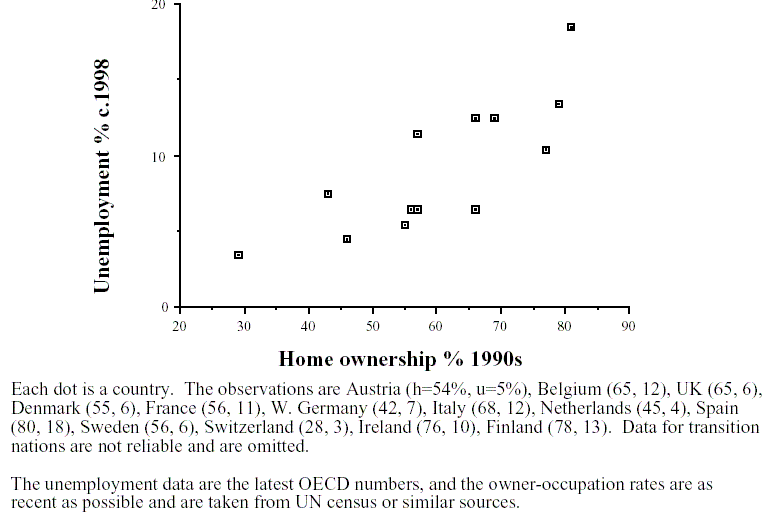
The 42 % for Germany surprises me on the low side, but may be due to the large density centers.
As for "significant", that's a slight understatement. Housing has held up household balance sheets; when the air goes it won't look good.
|
|
| |
|
|
|
Colon
|
 |
Antwerp, Colon's Chocolate Canard Country
Jan 1970
time: 06:23
|
|
quote:
Originally posted by DanS
"You're just ducking the question aren't you?"
Well, not really. Or at least mostly not. I'm just hedging my bets because I don't have a clear sense of how Sony approaches it normally. Also, the explanation is perhaps too long for this thread (and it's only a 1/2 formed opinion anyway). But I'll give it a go.
I have a pretty good sense of how Philips does it. Philips appears to use a standard library of in-house functional blocks which are used in concert to create a single integrated circuit that does a specified task. The IC is then sent out to a fab house (demand is probably pooled among several different internal customers). Sometimes Philips creates its own DVD players, etc. with its own ICs--very rarely with others' ICs. Let's assume that Sony goes with this approach on the PS2, and the fab and assembly houses are its own.
Nintendo uses a somewhat similar approach with the Gamecube. Instead of using an in-house functional block library, it rents others' libraries. However, not all functional blocks are available for rent (for instance, I don't think nVidia would allow Nintendo to license its functional blocks). With these functional blocks it then creates three or four ICs to do all of the tasks needed for the entire machine. Send the plans to the fab house (contract) and then assembly (contract?).
Microsoft does business differently. A good portion of the task is completed by generic ICs (and other ICs that are normally used in a PC context), and an operating system that serves as an interface between the hardware and software on a more abstract level than the PS2 and the Gamecube. For instance, the XBox uses a Pentium III 733 MHz CPU--the same one that you buy off the shelf for your PC. A ~ GeForce 4 chipset. DDR memory sticks that you could buy off the shelf.
Microsoft uses none of its own parts. The only hardware it designs is the PCB. The operating system, programming tools, etc. are largely borrowed from Windows XP. All fab and assembly is contract. Microsoft can choose among several different vendors for all of the parts that it buys.
Which of the three approaches makes the most business sense to you?
[NB: There is a fourth, new, way to do it--the soft hardware approach. But none of the three use this approach.] |
I don't know about the PS, but Sony isn't zealous about using in-house components. The Vaio laptop is essentially a Toshiba with a Sony brand, a Sony slick design and network features to make it compatible to other Sony devices.
You can't really tell which production approach makes most sense because you don't know the unit costs. Using of-the-shelf components to assemble a console instead of designing them to that purpose might seem sensible but I don't know whether it's as cost-efficient.
Maybe I'm underestimating MS's efforts but I think many firms could design a console like that which means MS still has to rely on superiority in other fields to tilt the balance in its favour.
|
|
| |
All times are GMT. The time now is 05:23.
Apolyton Time is 00:23. |
top of page
|
| archivepost |
|
Forum Rules:
You may not post new threads
You may not post replies
You may not post attachments
You may not edit your posts
|
HTML code is ON
vB code is ON
Smilies are ON
[IMG] code is ON
|
|
|
|
|
|





 10-12-2002 13:44


 But my point was that the multifactor measure is more relevant (and lower) than attributing all productivity to labor.


 Attachment:


 |
|