|
| |
|
| |
|

|
DanS
|
 |
Kickball Capital of the World
Jan 1970
time: 00:23
|
|
I have been quite impressed with MS lately. They are choosing their shots and most of the initiatives you mention are right down their alley--software and operating systems.
*X-Box is a better console than Sony's and MS should win out in this market in the 4-6 year timeframe -- Asian low-cost, outsourced manufacturing base, American hardware and software IP, by and large
*MS has chosen an excellent way of selling their OS for handsets. Not that creating generic reference designs is a new concept, but it should work extremely well in the current commodity manufacturing environment; MS should have a sizeable slice of this market in the 3-5 year timeframe, if they execute, and the Taiwanese contract manufacturers will be rich because of it -- Lowest cost manufacturing base, American hardware and software IP
*Embedded XP should continue to pick up contracts here and there; big battle between it and Linux, but this is the type of market where it's difficult to dominate and could become a market where everybody wins
One of the only areas where I'm skeptical where they're heading is MSN dial-up and broadband. The US market is mature for dial up; broadband is too expensive to hit mass appeal. Don't know where they're going to get big numbers.
But I'm not at all concerned with imperial overstretch, as long as they keep to their core competency. Don't know too much about the SAP angle. Perhaps you could enlighten?
Its financials are stunning.
Last edited by DanS on 07-12-2002 at 04:02
|
|
| |
|
|
|
DanS
|
|
Kickball Capital of the World
Jan 1970
time: 00:23
|
|
Hmmm... Snow as the new Treasury Secretary. Salesman for a new round of tax cuts upcoming.
Adam Smith: Do you have anything to say about him?
http://www.washingtonpost.com/wp-dy...0-2002Dec8.html
I'm glad that Bush didn't give in and go for a Wall Street banker. I seem to remember meeting him at a political fundraiser at Union Station about 10 years ago, although I can't remember for sure.
ef: Taking your spreadsheet and doing some 5-year averages, I note that the late 90s hasn't been beaten since the 60s.
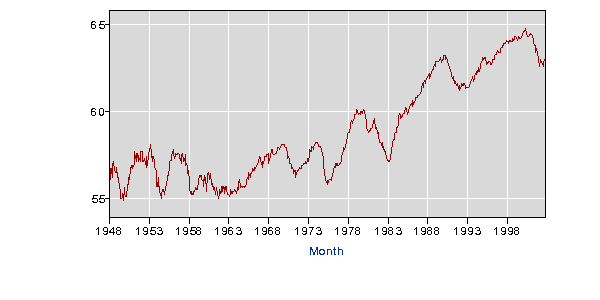
On both hours and participation rate, the reductions seem modest to me overall. BLS says that the workweek reduction over a couple of decades is about 50 hrs per annum total. I would be interested in knowing Europe's reductions. And the employed/pop ratio seems to always go down at a recession (see attached). The participation rates don't show such nice distinct hills and valleys.
We might see a repeat of the "jobless recovery" of the 90s. Also, the 60s and 90s look awful similar on this chart.
 Attachment: lfs1600000_122648_1039413312876.gif Attachment: lfs1600000_122648_1039413312876.gif
This has been downloaded 31 time(s).
Last edited by DanS on 09-12-2002 at 11:18
|
|
| |
|
|
|
HershOstropoler
|
|
AS:
"Why would EU use either measure?"
There are measures per hour, too. However, labour market stats are extremely unreliable. The BLS is using a fudge factor of 100k-200k per month for the payrolls, and does big revisions. A change in german social security law lead to almost 2 million employed showing up, mostly in the low wage/few hours category. The nr of hours is even less reliable, so it's just a funny number guessing.
"Attributing all productivity gains to labor overstates labor productivity. Why not use multifactor?"
Well the BLS labour productivity figures are output/hour, too.
As for US labour force growth, it's been growing very fast through the 90s. Most of that extra growth was artificial, the bubble economy drew in marginal workers. Now it's being corrected.
As for treasury, I'm surprised they don't bring in a Rubin clone. But looks like a package deal - at least the econ adviser will be a speculator *****.
|
|
| |
|
|
|
HershOstropoler
|
|
Payroll growth was about 2 %, some of that may have been revised away. "Marginal" is a bit lose to describe what I mean; the couple million in extra immigration also owe partly to the bubble, and I think we can expect some reversal there.
|
|
| |
|
|
|
HershOstropoler
|
|
I haven't had the time to go through the numbers in detail, but 1.6 % looks about right.
"Well, the population estimates show that the peak of growth for population was in the early 1990's"
I have the census office guesstimates:
Jan 1990: 248.8
Jan 1995: 264.8
Jan 2000: 280.7
That looks pretty even. Also those nrs are recalculated; given that they erred by a couple million for their 2000 estimate, I do not put much faith in their reconstruction of the annual developments.
"Already happened - didn't you seem my post earlier (on page 5) about the US's falling population growth?"
I saw it, and the point was an explanation for the falloff in labour supply growth. But you're right, after the census and BLS revisions the picture looks a lot less clear.
|
|
| |
|
|
|
DanS
|
|
Kickball Capital of the World
Jan 1970
time: 00:23
|
|
Re the falling population growth, I would need a lot more corroborating evidence to believe it. The US Census Bureau hasn't been known to keep good tabs on immigration and there are a lot of ways for extra people to be hidden in the good old US of A (by conscious compromise design, I'm convinced).
If there's a dip in the growth rate, I would say it has a lot more to do with 9/11 and subsequent documentation crackdowns than the bubble economy.
Last edited by DanS on 09-12-2002 at 20:41
|
|
| |
|
|
|
DanS
|
|
Kickball Capital of the World
Jan 1970
time: 00:23
|
|
And like Roland, I would put zero stock in those numbers, as these growth rates were probably just smoothed in order to close the books. The Census Bureau originally pegged population growth at 0.9% for the 90s too.
You put way too much confidence in our government's ability and desire to report accurate numbers for immigration. There's a reason why they didn't get it right the first time, you know.
Last edited by DanS on 09-12-2002 at 21:16
|
|
| |
|
|
|
Colon
|
 |
Antwerp, Colon's Chocolate Canard Country
Jan 1970
time: 06:23
|
|
quote:
Originally posted by DanS
I have been quite impressed with MS lately. They are choosing their shots and most of the initiatives you mention are right down their alley--software and operating systems.
*X-Box is a better console than Sony's and MS should win out in this market in the 4-6 year timeframe -- Asian low-cost, outsourced manufacturing base, American hardware and software IP, by and large |
Odd you mention X-Box right after OS's and software. I never understood MS engaged itself in creating the box on which software operates. It doesn't do this with handsets and wouldn't dream of doing it with PC's either.
The introduction to the company on www.microsoft.com is full of references to software and X-Box just doesn't fit in that.
Besides, X-Box may be technically superior but remember this thing isn't supposed to be an engineer's wet dream. (lots of similar projects crashed on the misconception that technical superiority suffices) It's the marketing side that makes the difference in consumer electronics, and Sony has tremendous experience at this field.
Not even mentioning the fact that Sony actually makes a profit out of consoles while MS apparently doesn't. (I don't believe MS released profit figures on the X-Box but the company reportedly only makes a profit out of Windows and Office)
quote:
*MS has chosen an excellent way of selling their OS for handsets. Not that creating generic reference designs is a new concept, but it should work extremely well in the current commodity manufacturing environment; MS should have a sizeable slice of this market in the 3-5 year timeframe, if they execute, and the Taiwanese contract manufacturers will be rich because of it -- Lowest cost manufacturing base, American hardware and software IP |
You forget looking about what the competition has in its store. (Symbian in this case)
MS allows to alter the userface, Symbian allows to alter the source code as well. Not so long ago MS suffered a large symbolic defeat when Sendo, a British handset producer switched from MS to Symbian, exactly because it couldn't get access to the source code.
And if Nokia should have taught you anything, it is that handset are fashion products as well as just a tool to call people with. Branding and slick design matters and the established manufacturers, as in the case of Sony, are very skilled at this. Next to that does a company like Nokia posses large scale of economies and a very efficient logistics system.
MS strategy of circumventing the established handset producers might work in the lower end of the market where the fashion aspect isn't much of an issue, but MS still lacks scale of economies to get a decent profit margin out of it.
quote:
One of the only areas where I'm skeptical where they're heading is MSN dial-up and broadband. The US market is mature for dial up; broadband is too expensive to hit mass appeal. Don't know where they're going to get big numbers. |
Broadband seems to be a problematic market in the US yes. I find it stunning that the largest ISP in the US is so recalcitrant to enter broadband, while the telcos in Europe couldn't rush in fast enough.
quote:
But I'm not at all concerned with imperial overstretch, as long as they keep to their core competency. Don't know too much about the SAP angle. Perhaps you could enlighten? |
What's their core competency according to you? Why is X-Box part of it?
Can they effectively fight Nokia on one front, Sony on another, and Linux on a third one, whilst being distracted by litigation?
MS bought Great Plains vendor of enterprise software a year ago. SAP was also designing enterprise portals which has the potential to replace the Windows desktop.
Next to that MS had plans to design enterprise portals itself.
That created discussion about SAP and MS heading for a battle but I haven't heard much of it since actually.
quote:
Its financials are stunning. |
They are now, they need to be, we'll see how much of that is left after a decade.
|
|
| |
|
|
|
DanS
|
|
Kickball Capital of the World
Jan 1970
time: 00:23
|
|
"Can they effectively fight Nokia on one front, Sony on another, and Linux on a third one, whilst being distracted by litigation?"
Sure. Remember that they were fighting on PC OS, Office, and browser software a couple of years ago. Re litigation, they've been focusing on their products amidst even breakup litigation. Very impressive.
MS' core competency is software. I wouldn't limit it beyond that. They do very well in almost all areas of software, including PC games.
"full of references to software and X-Box just doesn't fit in that."
Sure it does. They're just using standardized parts from the PC industry to create the box. Then they're refreshing their bill of materials aggressively and often for price. The OS is merely a form of Windows XP.
"MS strategy of circumventing the established handset producers might work in the lower end of the market where the fashion aspect isn't much of an issue, but MS still lacks scale of economies to get a decent profit margin out of it."
They're pretty early in challenging the handset guys. I've seen the Taiwanese/Chinese manufacturers absolutely crater costs before--in the 1m qty, not the 400m qty. True, I haven't seen them be too sharp with fashion, but I'm not ruling out their abilities in that regard.
|
|
| |
|
|
|
Adam Smith
|
 |
Maryland, USA
Jan 1970
time: 00:23
|
|
DanS:
I met and workied with John Snow a couple of times when I was working for my previous employer. I am a bit surprised at his apparently being named. He is more like a corporate elder statesman than a finance type like Robert Rubin. To me Snow seems better suited to explain corporate / regulatory issues (eg., Clean Air modifications) than Treasury / finance / deficit issues. He appears to be more familiar with microeconomic issues than macroeconomic issues. He has plenty of experience in selling a policy, (as a railroad executive he helped lead the effort to deregulate the railroad industry in 1980, and was also prominent in the ongoinog fight against larger, heavier trucks), but that is what the White House has legislative people for. His Republican credentials are impeccable, and he was probably recommended by Cheney. Snow also has good relations with moderate Democrats, so he is probably going to be closer to Senate republicans than House republicans.
ef, Roland:
I will grant that all measures have noise in them, though its always disturbing to realize how much noise.  But my point was that the multifactor measure is more relevant (and lower) than attributing all productivity to labor. But my point was that the multifactor measure is more relevant (and lower) than attributing all productivity to labor.
|
|
| |
|
|
|
Colon
|
|
Antwerp, Colon's Chocolate Canard Country
Jan 1970
time: 06:23
|
|
quote:
Originally posted by DanS
Sure. Remember that they were fighting on PC OS, Office, and browser software a couple of years ago. Re litigation, they've been focusing on their products amidst even breakup litigation. Very impressive. |
That's an odd sentence. I wouldn't have expected any else than they would have kept focused on their products. 
But you can hardly compare the resources Netscape and Lotus had to their disposal with those of the current competitors.
quote:
MS' core competency is software. I wouldn't limit it beyond that. They do very well in almost all areas of software, including PC games. |
I know, but X-Box is hardware.
quote:
Sure it does. They're just using standardized parts from the PC industry to create the box. Then they're refreshing their bill of materials aggressively and often for price. The OS is merely a form of Windows XP. |
You're using very strange thought patterns now Dan. X-Box is hardware, a console, a consumer electronic, not an OS. Or would you call a PDA or a PC a form of OS too?
And it's hardly a matter of jumbling together several standardised parts. The marketing aspect is where the difference is made. How do you design products that are both fashionable and functional, how do you set up the distribution system, how do you communicate with your consumers and so forth. Sony has been succesfully doing this for ages while MS has zero experience.
quote:
They're pretty early in challenging the handset guys. I've seen the Taiwanese/Chinese manufacturers absolutely crater costs before--in the 1m qty, not the 400m qty. True, I haven't seen them be too sharp with fashion, but I'm not ruling out their abilities in that regard. |
MS isn't the only one who makes use of an Asian manufacturing base.
And consider the logistics issue as well, Dell has been triumphing in PC land because of its superior organisation at this field, and Nokia is admired for its logistics as well.
Last edited by Colon on 09-12-2002 at 23:59
|
|
| |
All times are GMT. The time now is 05:23.
Apolyton Time is 00:23. |
top of page
|
| archivepost |
|
Forum Rules:
You may not post new threads
You may not post replies
You may not post attachments
You may not edit your posts
|
HTML code is ON
vB code is ON
Smilies are ON
[IMG] code is ON
|
|
|
|
|
|





 07-12-2002 02:38


 (where did all these lovely smilies suddenly come from?)

 )
)

 |
|